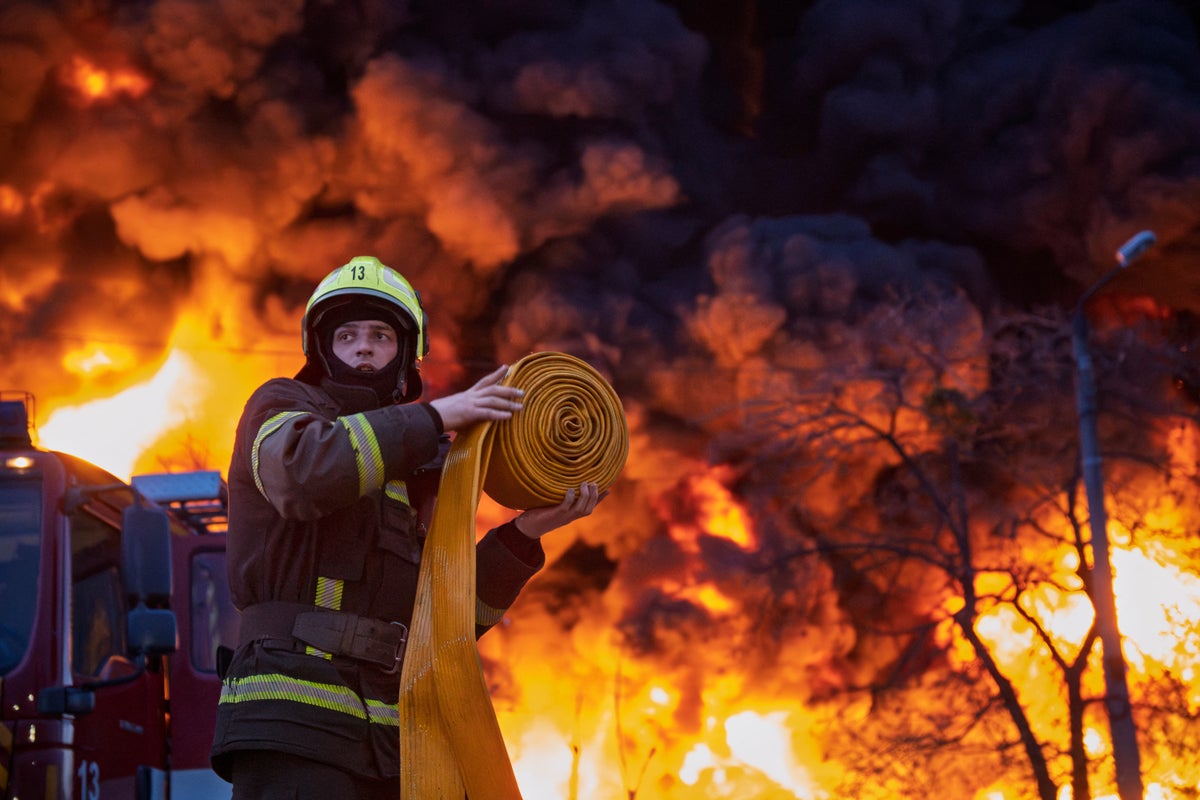
The siren didn't just wail in Kyiv last night. It screamed across the entire country, marking a grim milestone in a war that many outsiders have dangerously started to tune out. Russia just launched its deadliest aerial assault of 2026, and the sheer scale of the carnage is a wake-up call that "fatigue" is a luxury the world can't afford. When President Volodymyr Zelensky stood before the cameras and labeled Vladimir Putin a global threat, he wasn't just using flashy rhetoric for a headline. He was stating a cold, hard fact backed by 700 drones and dozens of missiles that rained down on civilian heads while they slept.
This wasn't a tactical strike on a military base or a frontline skirmish. This was a deliberate attempt to break the spirit of a nation by targeting the places where people feel safest. Discover more on a similar issue: this related article.
The Night the Sky Fell
Russia's latest barrage was nothing short of a coordinated nightmare. According to the Ukrainian Air Force, Moscow's forces utilized a terrifying mix of nearly 700 Shahed-type drones along with ballistic and cruise missiles. Most were intercepted—667 of them, to be exact—but the ones that got through did catastrophic damage.
The human cost is staggering. In Kyiv, four people died, including a 12-year-old child. Think about that for a second. A kid who should have been worrying about school on a Friday morning was instead pulled from the rubble of an apartment block. In Odesa, the toll was even worse, with nine people confirmed dead after missiles slammed into a high-rise building and critical port infrastructure. Additional journalism by The Guardian explores related perspectives on this issue.
Here’s why this specific attack is different from the daily grind of the last four years:
- Massive Volume: Nearly 700 drones in a single wave is a saturation tactic designed to bleed air defense dry.
- Geographic Spread: From the southern ports of Odesa to the central hub of Dnipro and the capital, no corner was spared.
- Precision Cruelty: The hits on residential zones weren't "accidental" leftovers of intercepted debris. They were targeted.
A Global Threat Is Not a Hyperbole
Zelensky’s language has shifted recently. He’s no longer just asking for help to save Ukraine; he’s warning that the wildfire is about to jump the fence. By calling Putin a global threat, he’s pointing to the reality that if Russia’s "death from above" strategy succeeds, the playbook for 21st-century warfare changes for everyone.
If a nuclear-armed state can systematically erase the civilian infrastructure of its neighbor without facing total isolation, what stops the next guy? Honestly, the "global threat" isn't just about the missiles. It's about the erosion of the very idea that civilians are off-limits. Moscow is banking on the world getting bored of the tragedy. They want you to see "18 dead in aerial attack" and just keep scrolling.
The Air Defense Crisis Nobody Wants to Face
We need to talk about the math of this war because it’s getting ugly. Ukraine is shooting down about 90% of what Russia throws at them. That’s an incredible feat of engineering and bravery. But there's a catch that military experts are whispering about in the hallways of Brussels and Washington: the interceptors are running out.
It costs significantly more to shoot down a drone than it does to build one. Russia is using cheap, mass-produced "moped" drones to force Ukraine to use its expensive Patriot and Iris-T missiles. It’s a war of attrition where the "shield" is much more expensive than the "sword." Zelensky’s recent push for a "joint sky defense system" with European partners isn't just a wish list—it’s a survival requirement. Without a unified European net, Ukraine's shield eventually cracks.
What This Means for You
It's easy to look at a map of Eastern Europe and feel like it's a world away. It isn't. The economic ripples of the Odesa port strikes affect global grain prices. The technological leaps in drone warfare seen last night will eventually end up in the hands of every insurgent group on the planet.
More importantly, the diplomatic precedent being set right now is the foundation of the next decade. If the international community allows "deadliest of the year" to become a recurring, ignored headline, the "global threat" Zelensky warned about becomes a global reality.
Don't let the numbers numb you. Eighteen lives lost in a single night of "peace-time" sleeping is an atrocity, not a statistic. The immediate next step for the international community isn't just another round of "deep concern" on social media. It's the unblocking of long-range capabilities and the immediate replenishment of interceptor stocks. The sky is falling, and we're the only ones who can help hold it up.