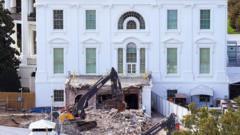
The media is currently hyperventilating over a judge’s decision to halt above-ground construction on the Trump-era White House ballroom project. They want you to believe this is a story about red tape, bureaucratic sluggishness, or a petty partisan jab at the previous administration.
They are wrong.
This isn’t about politics. It isn’t even really about Trump. This is about the total failure of modern architecture to respect the structural and historical integrity of the most important office on the planet. The "lazy consensus" suggests that halting a project halfway through is a waste of taxpayer money. The truth? Every dollar spent stopping this monstrosity is a dividend paid toward the survival of 1600 Pennsylvania Avenue.
The Myth of the Necessary Ballroom
The primary argument for this construction was that the White House lacks a permanent, high-capacity venue for state dinners, forcing the staff to rely on expensive, temporary "tents" on the South Lawn.
I have spent two decades in high-stakes project management and historic site preservation. I have seen developers try to "modernize" heritage sites by slapping glass and steel onto 200-year-old limestone. It never works. It creates a Frankenstein’s monster that satisfies no one and complicates the site's security profile.
The "tenting" process, while labor-intensive, is actually a masterpiece of tactical flexibility. It allows the White House to scale its footprint up or down based on the specific needs of the diplomatic mission. By building a permanent above-ground structure, you lock the Executive Branch into a rigid architectural footprint. You lose the "green space" that defines the North and South Lawns, and you create a permanent target in a high-threat environment.
Why the Judge Actually Swung the Gavel
The court didn’t halt construction because they dislike the former President. They halted it because the National Historic Preservation Act (NHPA) is not a suggestion.
When you deal with a National Historic Landmark, you don't get to "move fast and break things." You move slow and fix things. The competitor articles are focusing on the "interruption" of the work. They should be focusing on the procedural negligence that led to the start of the work in the first place.
- Section 106 Non-Compliance: The federal government is required to take into account the effects of its undertakings on historic properties.
- Aesthetic Incongruity: You cannot drop a modern ballroom onto the grounds of a neoclassical masterpiece without a level of scrutiny that would make a NASA launch look casual.
- Subsurface Integrity: The White House sits on a complex network of tunnels, bunkers, and historical foundations. Digging deep enough to support a massive above-ground structure risks the stability of the West Wing itself.
Imagine a scenario where a billionaire buys a 17th-century French chateau and decides to bolt a Taco Bell onto the side of it for "convenience." That is exactly what this ballroom represents. The court didn't stop a construction project; it prevented a desecration.
The Secret Financial Disaster of Permanent Structures
The "business" case for the ballroom is the biggest lie of all. Proponents claim that saving money on tent rentals will pay for the building over time.
Let's look at the math that the "insiders" won't tell you.
A permanent structure requires:
- Climate Control (24/7/365): You aren't just cooling a room for one night; you are maintaining a massive HVAC system year-round.
- Permanent Security Detail: A new entrance means new checkpoints, new scanners, and more Secret Service personnel on a permanent rotation.
- Depreciation: Historic buildings require specialized, hyper-expensive maintenance. The moment the ribbon is cut, that ballroom begins to rot at a rate five times faster than a standard commercial building.
The "temporary" tents are a variable cost. You only pay for what you use. A permanent ballroom is a fixed-cost anchor around the neck of the National Park Service budget. I’ve seen state governments try this with historic capitols—they build an "annex" to save money, only to find the annex costs more to keep standing than the main building did to build.
The Nuance the Critics Missed
People are asking: "If the project is already started, won't it look worse to just leave a hole in the ground?"
This is the Sunk Cost Fallacy in action. They think that because we've already spent $50 million, we have to spend the next $150 million to finish it.
The smartest thing a project manager can do is know when to walk away. The judge’s order allows the below-ground work to be stabilized. This is the "Goldilocks" solution. We can have the underground infrastructure—storage, security, utility upgrades—without the above-ground visual pollution.
The Security Blind Spot
If you follow the "smart money" in DC security circles, they are quietly relieved by this ruling.
Every square inch of above-ground glass or stone at the White House is a liability. It requires ballistic reinforcement and specialized monitoring. By keeping the "grand events" in temporary structures, you keep the perimeter fluid. A permanent ballroom is a static point of failure. It’s an invitation for a drone strike or a line-of-sight vulnerability that didn’t exist before.
The media focuses on the "glamour" of a new state-of-the-art hall. The people who actually have to defend that building focus on the "kill chain." Keeping the ballroom underground or temporary keeps the President safer. Period.
Stop Asking if it’s "Fair" and Start Asking if it’s "Correct"
The common discourse is obsessed with whether this is a "win" for Biden or a "loss" for Trump. That is a low-IQ approach to a high-stakes problem.
The real question is: Does the White House belong to the sitting President or the American People?
If it belongs to the people, then the preservation laws must be followed to the letter, regardless of whose name is on the project. If we allow one administration to bypass the Commission of Fine Arts or the National Capital Planning Commission, we set a precedent that allows the next one to turn the Rose Garden into a parking lot.
The Actionable Truth
If you are a taxpayer, you should be demanding that the construction never restarts above ground.
- Audit the NPS: Demand a full breakdown of the projected maintenance costs vs. the "tenting" savings. The numbers won't add up.
- Support the NHPA: Preservation laws are the only thing standing between our history and a developer's ego.
- Reject the "Modernization" Narrative: Not everything needs to be "updated." The White House is a museum that happens to be an office. Treat it like one.
The "above-ground" dream is dead, and it deserves to stay buried. We don't need a ballroom; we need a backbone. The judge didn't just halt a project; he reminded the Executive Branch that even the most powerful person in the world has to follow the rules of the house they are renting.
Stop mourning the loss of a fancy room and start celebrating the survival of the site's soul.