The air in a professional snooker arena doesn't circulate like normal oxygen. It is heavy, filtered through thick wool waistcoats and pressurized by the held breath of a thousand people who are terrified of making a sound. In the center of this vacuum stands a table of baize so green it looks radioactive under the TV lights.
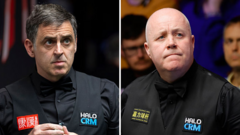
Ronnie O’Sullivan stands at the edge of it. He is fifty years old, though his eyes carry the weight of a century. Across from him sits John Higgins. They were born in the same year, 1975. They turned professional in the same year, 1992. For three decades, they have been the two halves of a single, agonizing question: What happens when the greatest natural talent in history meets the most unbreakable will ever forged?
Most rivalries burn out in five years. Ten, if the athletes are lucky. But O’Sullivan and Higgins have been playing this psychological chess match since before some of their current opponents were born. To understand why their latest meeting isn't just another tournament fixture, you have to understand the invisible stakes. This isn't about a trophy or a check. It is about two men staring into a mirror and seeing their own mortality reflected in the other’s cue action.
The Architect and the Artist
Imagine two ways to build a cathedral.
One man, Higgins, is the master mason. He places every stone with a mathematical precision that defies the elements. He doesn’t care if the weather is turning or if the tools are blunt. He will find a way to make the structure stand. He is "The Wizard of Wishaw," a nickname that feels too whimsical for a man whose game is built on the cold, hard logic of match play. When Higgins is at the table, the balls don't just fall; they are coerced into submission.
Then there is O’Sullivan. He doesn't build; he exhales. Watching "The Rocket" in full flow is like watching someone describe a dream while they are still having it. He plays with a speed that suggests he can see three minutes into the future. There is a frantic, beautiful instability to him.
For thirty years, these two philosophies have collided.
Higgins represents the triumph of the grind. He is the man you send to win a frame when your life depends on it. O’Sullivan is the man you pay to watch because he reminds you that human beings are capable of brief, flickering moments of perfection. When they play each other, it is a battle between the Unstoppable Force and the Immovable Object. But here is the secret: after thirty years, the force is getting tired, and the object is starting to show cracks.
The Weight of the Wood
A snooker cue is just a piece of ash or maple, usually about 57 inches long. But after three decades of high-level competition, that piece of wood starts to feel like a lead pipe.
Lesser players fade away because their eyes go, or their hands lose that microscopic steadiness required to strike a ball exactly 1.5 millimeters to the left of center. But for O’Sullivan and Higgins, the physical decline is secondary to the mental erosion. Imagine doing the same high-pressure task every day for 11,000 days. Every miss becomes a scar. Every loss becomes a ghost that follows you to the next hotel room.
They talk about "renewing the rivalry" as if it’s a fresh coat of paint. It isn’t. It’s a reopening of old wounds.
When they stepped out for their latest encounter, the atmosphere shifted. The crowd wasn't just cheering for a winner; they were witnessing a living museum. There is a specific kind of hush that reserved for them. It’s the sound of collective memory. People in the audience remember where they were when these two first played in the nineties. They see their own aging in the graying hair of the men at the table.
The Invisible Stakes
Why do they keep doing it?
O’Sullivan has often spoken about his love-hate relationship with the game. He has threatened to retire more times than most people change their oil. He finds the circuit soul-destroying, the travel tedious, and the pressure suffocating. Yet, he returns.
Higgins, conversely, is a purist who seems haunted by the fear that his best days are behind him. He has spent recent seasons searching for a "feeling" that used to come naturally. He tinkers with his technique like a man trying to fix a watch in the dark.
The stakes in an O’Sullivan-Higgins match are "invisible" because they aren't on the scoreboard. The real score is internal.
- Can I still do this when he is watching?
- Does he still fear me?
- Am I still the man I was in 1998?
There is a technical phenomenon in snooker called "the twitch." It is the moment the nervous system rebels against the mind. It happens to the best of them. The cue arm, usually a piston of pure muscle memory, gives a tiny, involuntary jerk at the moment of impact. It is the physical manifestation of doubt.
When these two play, they are hunting for that twitch in the other man. They are looking for the moment the legend becomes human.
The Geometry of Survival
The match unfolds in chapters.
In the early frames, it's often O’Sullivan who dictates the tempo. He moves around the table like he’s late for a bus, picking off long pots and stitching together breaks with a terrifying fluidity. If you blinked, you’d miss the genius. He makes the game look like it’s being played on a larger table with bigger pockets.
But then, the tide shifts. Higgins starts to "tighten" the game. He plays safety shots that leave the cue ball frozen against the bottom cushion, miles away from any red. He turns the match into a war of attrition. He forces O’Sullivan to sit in his chair and think. And for Ronnie, thinking has always been the most dangerous part of the game.
This is where the human element becomes almost unbearable to watch. You see O’Sullivan’s leg start to jiggle. You see Higgins wipe sweat from his forehead with a trembling hand. These are multi-millionaires, icons of the sport, yet they are reduced to the raw vulnerability of schoolboys in a playground.
They aren't playing against each other. They are playing against the version of themselves that exists in the record books.
The Shared Loneliness
There is a profound loneliness at the top of any individual sport. In a team, you can hide. In snooker, you are alone on a stage, under a microscope, for hours on end.
The only person in the world who truly understands what it feels like to be Ronnie O’Sullivan is John Higgins. And vice-versa. They are the last two survivors of the "Class of '92," a legendary group of players who redefined the sport. Everyone else from that era has either retired, moved into the commentary box, or faded into the lower rankings.
They are the two trees left standing after a forest fire.
That creates a strange, unspoken bond. You see it in the way they shake hands at the end. It isn't the perfunctory grip of two professionals. It is the embrace of two soldiers who have survived the same campaign. There is a deep, agonizing respect there.
Higgins recently remarked that playing Ronnie is "something special." It sounds like a cliché. It isn't. When he says those words, he is acknowledging that O’Sullivan is the only person capable of dragging the absolute maximum out of him. He needs Ronnie to know he’s still alive.
The Sunset of the Giants
We are currently living through the long, slow sunset of the greatest era snooker has ever known.
The modern game is filled with young, athletic players who have been trained in academies and have perfect, textbook techniques. They are efficient. They are consistent. They are also, largely, boring. They lack the "scars" that make O’Sullivan and Higgins so compelling.
When Ronnie steps into a shot, you are seeing thirty years of brilliance and thirty years of personal demons fighting for control of his arm. When Higgins lines up a double, you are seeing a man who has rebuilt his life and career after controversies and slumps that would have destroyed a lesser character.
The "core facts" of their latest meeting—the scores, the centuries, the result—are ultimately the least interesting things about it. The real story is that they are still here.
They are still standing under those hot lights, breathing that stale air, trying to prove that time hasn't caught them yet. They are playing for the ghost of who they used to be, and for the respect of the only person who knows how hard it was to get there.
One day, one of them will walk away for good. The table will be moved, the lights will be dimmed, and the vacuum will finally be filled with the sound of the outside world. But until then, every time they "renew the rivalry," we aren't just watching a game. We are watching a defiance of the inevitable.
The balls are scattered across the table like red stars in a green sky. Ronnie leans in. Higgins watches from the shadows. The clock is ticking, but for a few hours, they make it stop.