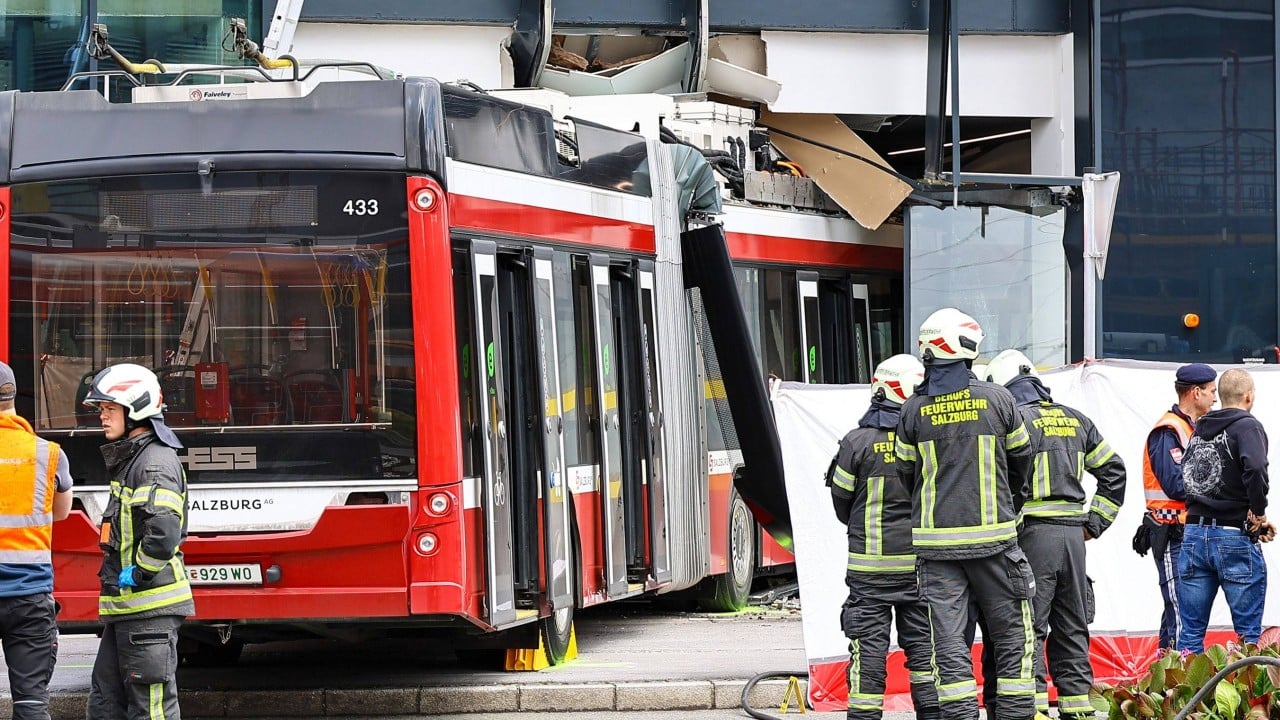
The collision of a high-mass electric trolleybus with a retail structure in Salzburg, Austria, represents a critical failure in the urban safety envelope. When a multi-ton vehicle transitions from a controlled transit vector to an uncontrolled ballistic object, the resulting damage is dictated by the intersection of three variables: kinetic energy dissipation, structural resistance of the built environment, and the presence of high-density pedestrian clusters. This incident, resulting in one fatality and six injuries, highlights a catastrophic breakdown in the fail-safe mechanisms inherent to modern public transportation systems.
The Mechanics of Kinetic Energy Transfer
The damage profile of the Salzburg crash is primarily a function of the trolleybus’s mass and velocity at the point of impact. Unlike passenger vehicles, a trolleybus possesses significant inertia that standard storefront architecture is not engineered to absorb. For a different view, see: this related article.
- Mass Magnitude: A standard two-axle trolleybus weighs approximately 13,000 to 19,000 kilograms when empty. This mass acts as a force multiplier even at low urban speeds.
- Velocity and Vector: At 50 kilometers per hour, the kinetic energy of a 15,000 kg vehicle is roughly $1.45 \times 10^6$ Joules. When this energy is directed into a glass-and-steel supermarket facade, the structure lacks the crumple zones necessary to decelerate the vehicle safely.
- Deceleration Rate: Because the building's support columns are rigid, the energy transfer occurs over a fraction of a second, resulting in peak force levels that liquefy non-load-bearing walls and turn internal fixtures into secondary projectiles.
This interaction creates a "penetration event" where the vehicle does not bounce off the structure but enters it, compromising the internal safety of the supermarket and trapping occupants between the bus and the building's internal load-bearing elements.
Human Factors and Control Logic Breakdowns
Urban transit systems rely on a layering of control mechanisms to prevent such incursions. The failure in Austria suggests a breach in one or more of these operational layers. Related insight regarding this has been provided by The New York Times.
The Biological Layer
The driver represents the primary control unit. In instances of sudden medical incapacitation or "pedal misapplication," the system depends on the human's ability to maintain situational awareness. If the driver loses consciousness, the vehicle continues along its last steered vector until interrupted by friction or impact.
The Mechanical Layer
Modern trolleybuses are equipped with "Deadman's Switches" or Driver Vigilance Systems. These require periodic input (tapping a pedal or button) to confirm the operator is active. If the input ceases, the vehicle is designed to initiate emergency braking. The fact that the vehicle reached the supermarket interior suggests either a high-speed trajectory that outpaced the braking system’s activation time or a mechanical override failure.
The Infrastructure Layer
Urban planning often fails to account for "run-off" zones at high-risk intersections. Where transit lines run parallel to high-density pedestrian zones, the absence of reinforced bollards or redirected traffic flow creates a vulnerability. The supermarket in this instance acted as the de facto kinetic energy absorber because the street-level infrastructure provided no resistive barrier.
The Three Pillars of Post-Collision Trauma
Survival in a high-mass collision event within a confined space depends on the immediate management of environmental hazards. The six injuries and one fatality reported follow a predictable distribution of trauma in structural incursions.
- Primary Blunt Force: Direct impact from the vehicle chassis. This is almost universally fatal for pedestrians or shoppers in the direct path of the bus.
- Secondary Fragmentation: Glass shards, shelving units, and masonry displaced by the bus. These cause the majority of non-fatal injuries in retail environments.
- Entrapment Dynamics: The physical presence of the bus inside the structure complicates extraction. The weight of the vehicle can cause partial floor collapses or pin victims against interior walls, requiring specialized heavy-lifting equipment from emergency services.
Operational Risk Mitigation Strategies
Public transit authorities must treat this event not as an isolated accident, but as a data point in a broader systemic risk assessment. The objective is to move from reactive emergency response to proactive kinetic containment.
Hardening Transit Nodes
Strategic placement of K-rated bollards (engineered to stop a 6,800 kg vehicle at 50 kph) at high-density retail intersections is the only reliable method for preventing vehicle-to-building incursions. Relying on driver health or software-based braking is insufficient given the physics involved.
Integration of Autonomous Emergency Braking (AEB)
While common in passenger cars, AEB integration in heavy transit vehicles faces challenges due to passenger safety. A sudden emergency stop can cause "internal" injuries to standing passengers. However, the trade-off between several minor falls on the bus versus a fatal structural incursion must be recalibrated. Sensors must be tuned to prioritize external collision avoidance over internal passenger stability when a high-velocity impact is imminent.
Telemetry-Based Health Monitoring
The implementation of real-time biometric monitoring for drivers can provide an early warning system for medical distress. If a driver’s heart rate or oxygen saturation deviates from established baselines, a remote system can initiate a controlled slowdown before the vehicle enters a critical collision path.
Infrastructure Resilience and Urban Survival
The Salzburg event underscores a fundamental tension in urban design: the proximity of heavy transit to fragile commercial spaces. As cities densify, the "safety buffer" between 15-ton moving objects and glass-fronted buildings continues to shrink.
The immediate strategic priority for urban planners is the "Kinetic Audit." This involves mapping transit routes against "Soft Targets"—buildings with high foot traffic and low structural resistance. Identifying these high-risk zones allows for the deployment of passive defense measures, such as reinforced street furniture or raised curbs, which can divert a runaway vehicle's energy before it reaches the building envelope.
The failure in Austria was not merely a driver or mechanical error; it was a failure of the urban environment to absorb a predictable kinetic anomaly. True safety in mass transit requires an acknowledgment that the vehicle will, eventually, fail, and the surrounding infrastructure must be the final line of defense.


:strip_icc()/pic2513216.jpg)