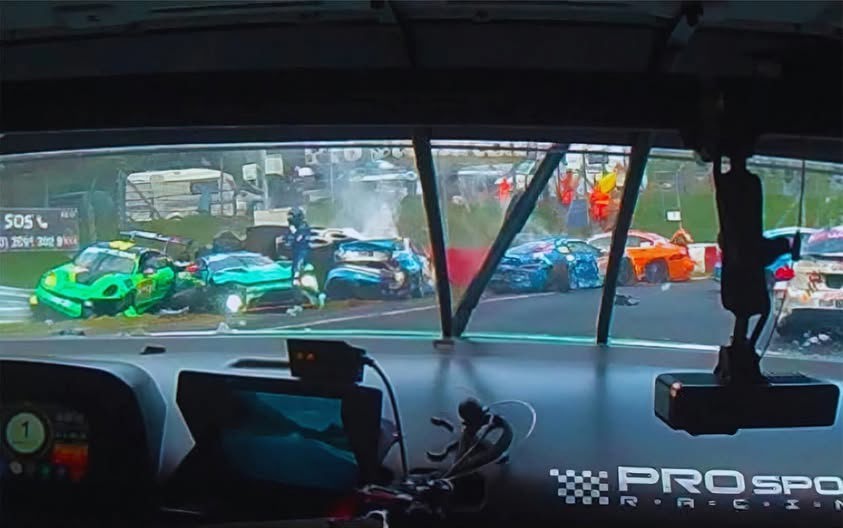
High-speed racing fatalities are rarely the result of a single mechanical failure; they are the terminal outcome of a kinetic chain reaction where safety margins are eroded by compounding variables. When a seven-car incident occurs, the primary driver of mortality is not the initial contact but the dissipation of energy through secondary and tertiary impacts. In professional motorsport, the difference between a survivable shunt and a fatal event is governed by the conservation of momentum and the integrity of the survival cell under non-linear loading. To understand the recent tragedy involving a multi-car pileup, one must analyze the physics of the "accordion effect" and the limitations of current deceleration technology.
The Mechanics of Kinetic Energy Dissipation
The severity of a multi-car collision is quantified by the total kinetic energy ($E_k$) present in the system at the moment of the first impact. This is expressed as: Don't forget to check out our previous coverage on this related article.
$$E_k = \frac{1}{2}mv^2$$
Where $m$ represents the mass of the vehicle and $v$ is the velocity. Because velocity is squared, an increase from 100 mph to 200 mph does not double the energy; it quadruples it. In a seven-car crash, this energy does not vanish. It is transformed into heat, sound, and structural deformation. If you want more about the context of this, The Athletic offers an excellent breakdown.
The primary danger in a pileup is the Directional Vector Mismatch. While modern F1 and GT cars are designed for frontal and side impacts (managed by the Nosebox and Side Impact Protection Structures or SIPS), they are less resilient against "T-bone" strikes or vertical intrusions. When a car spins and stops perpendicular to the racing line, it presents its most vulnerable aspect—the cockpit side—to oncoming traffic. The following vehicles, traveling at racing speeds, act as penetrators. If the closing speed is high enough, the force exceeds the shear strength of the carbon fiber monocoque, leading to catastrophic intrusion.
Three Pillars of Survivability Failure
The failure to survive a multi-car incident usually stems from one of three structural or physiological breakdowns:
- Chassis Saturation: Every energy-absorbing structure (crumple zone) has a maximum capacity. In a seven-car event, a single vehicle may be struck multiple times. Once the nosecone and rear crash structures are crushed in the first two impacts, the third impact transmits all remaining force directly to the driver’s spine and brain.
- The Delta-V Threshold: Human survivability is tied to the rate of change in velocity (Delta-V) over time ($t$). Even if the car remains intact, the internal organs—specifically the brain—continue to move at the original velocity until they strike the interior of the skull. If the deceleration occurs in less than 30 milliseconds, the G-loads can exceed 80G, which is frequently the limit of human physiological tolerance regardless of HANS device efficacy.
- Fire and Extrication Bottlenecks: In dense pileups, wreckage often interlocks. This creates a "mechanical cage" that prevents rapid medical intervention. If a fuel cell is compromised, the risk shifts from kinetic trauma to thermal injury, where the survival window is measured in seconds rather than minutes.
The Accordion Effect and Track Geometry
The spatial distribution of a crash is often a function of track design and visibility. On narrow street circuits or high-speed sections with blind crests, the "reaction chain" is broken. A driver at the back of a seven-car pack has a reaction time of approximately 0.2 to 0.5 seconds. At 200 mph, a car covers nearly 100 yards per second. If the line of sight is obstructed by a curve or debris, the driver is effectively blind to the hazard until they are within the "Point of No Return"—the distance required to scrub enough speed to make an impact survivable.
This creates the Chain Reaction Coefficient. Each subsequent car adds mass to the pileup, increasing the density of the wreckage and reducing the "escape lanes" for those following. The geometry of the track dictates whether cars will bounce back into the racing line (a high-risk scenario) or be funneled into a runoff area. When the track lacks sufficient gravel traps to bleed off speed, the concrete or TecPro barriers become the final, unforgiving decelerators.
Structural Integrity vs. Penetration Resistance
Modern racing seats and the Halo titanium structure have revolutionized driver safety, yet they face a specific limitation: Localized Load Pointing. The Halo is designed to withstand a 125kN vertical load, roughly equivalent to the weight of a double-decker bus. However, if a sharp component from another car—such as a suspension wishbone or a shattered wing assembly—strikes the driver at a specific angle, it can bypass these safety nets.
The "Seven-Car Variable" introduces a chaotic element where debris becomes ballistic. Carbon fiber, while incredibly strong under tension, becomes brittle and sharp when it shatters. In large-scale accidents, the risk of "secondary penetration" (debris entering the cockpit) rises exponentially with each involved vehicle. This is why tributes from peers often focus not just on the loss of a colleague, but on the sobering reminder that racing remains an exercise in managing unmanageable physics.
Human Factors and the Psychology of Risk
The emotional response from the racing community—manifested in tributes and public statements—serves a dual purpose. First, it acknowledges the shared risk inherent in the profession. Second, it often acts as a catalyst for technical reform. The history of motorsport safety is written in the aftermath of such events.
The psychological impact on surviving drivers involves a recalibration of their Risk-Reward Matrix. In the immediate wake of a fatality, the "invincibility bias" that allows drivers to find the limit is temporarily suppressed. This often leads to a measurable, though brief, decrease in aggressive overtaking maneuvers in the subsequent sessions.
Technical Evolution as a Response to Fatality
The path forward following a multi-car fatality typically follows a rigid investigative protocol:
- Telemetry Reconstruction: Analyzing the G-load sensors and pedal inputs of all seven cars to determine if "yellow flag" protocols were ignored.
- Material Fatigue Analysis: Examining the wreckage to see if any safety component failed below its rated threshold.
- Virtual Modeling: Re-running the crash in a physics engine to see if different barrier placements or car dimensions would have altered the outcome.
The objective is to move the "Fatal Limit" further out. If a crash at 150 mph is currently survivable, the engineering goal is to make 170 mph the new baseline. However, as long as cars compete in close proximity at high velocities, the risk of a "harmonic failure"—where multiple safety systems are overwhelmed simultaneously—cannot be reduced to zero.
Strategic Imperatives for Circuit Safety
The data suggests that to prevent future multi-car fatalities, the focus must shift from the car to the environment. Increasing the "Transparency of the Hazard" is the most effective way to break the kinetic chain.
- Digital Flagging Systems: Implementing cockpit-integrated LED displays that trigger the millisecond a sensor detects a high-G impact elsewhere on the track, bypassing the human delay of a flag marshal.
- Kinetic Buffers: Expanding the use of programmable barriers that vary their resistance based on the angle and speed of the incoming mass.
- Aero-Wake Management: Reducing the turbulence behind cars to ensure that following drivers have maximum braking stability when an emergency occurs.
The loss of a driver is a failure of the system's ability to contain energy. Future safety developments must prioritize "Energy Redirection"—ensuring that when seven cars occupy the same space at 200 mph, the force is directed away from the survival cell and into the environment. The focus must remain on the brutal reality of the physics: you cannot stop the impact, but you can control the duration of the stop. Increasing that duration by even a few milliseconds is the difference between a tribute and a post-race interview.