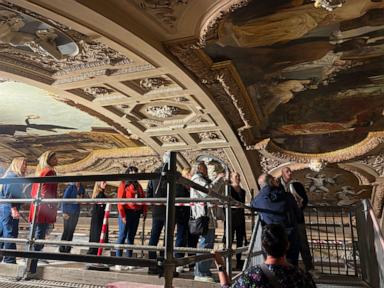
Art history is currently obsessed with "access." The logic is simple and flawed: if you bring the viewer closer to the brushstroke, they will somehow inherit the genius of the artist. Vienna’s Burgtheater is currently running "scaffolding tours" that allow visitors to climb up to the ceiling and stare Gustav Klimt’s early works in the face.
It sounds democratic. It feels intimate. In reality, it is a fundamental misunderstanding of how architectural art functions.
The Burgtheater ceiling paintings—specifically the Cart of Thespis and the Globe Theatre—were never meant to be seen from six inches away. By dragging the public up the ladders, we aren't "connecting" with Klimt. We are participating in a voyeuristic dissection of a work that requires distance to survive. This isn’t an art tour; it’s a high-altitude selfie op that mistakes proximity for profundity.
The Fraud of Macro-Perspective
Renaissance and Fin-de-Siècle masters understood optics better than our current "experiential" curators. These works were designed with specific foreshortening. They were painted to account for the curve of the vault and the massive distance between the marble floor and the plaster.
When you stand on a vibrating metal platform right in front of a figure, the proportions look grotesque. The perspective is shattered. You aren't seeing the painting; you are seeing the technical corrections Klimt made to ensure the painting looked "right" from 30 meters below.
Imagine taking a high-definition microscope to a pointillist masterpiece. You don't see the lady in the park; you see a chaotic mess of pigment. The Burgtheater tours do exactly this. They strip the work of its context and call it "education." True appreciation requires the humility to stay where the artist intended you to stand.
The High Cost of Human Humidity
Let’s talk about the physics of the "daily tour" that the headlines ignore.
The primary enemies of fresco and tempera on plaster are fluctuations in temperature and humidity. Every body you hoist onto that scaffolding is a walking radiator. A group of fifteen tourists exhales gallons of moisture and sheds thousands of skin cells over the course of an hour.
In a controlled museum environment, we obsess over climate. In a theater ceiling tour, we ignore it for the sake of ticket sales. I’ve watched historic surfaces in Italy and Austria degrade specifically because of "intimate" access. The salt efflorescence triggered by human breath is a chemical death sentence for delicate pigments.
We are literally breathing the art into extinction for a 15-minute thrill.
The "Company Art" Myth
Critics love to point to these early works as the "seeds of the Secession." That’s a convenient narrative for a brochure, but it’s historically lazy.
In 1888, when the "Künstler-Compagnie" (Gustav Klimt, his brother Ernst, and Franz Matsch) finished these commissions, they weren't rebels. They were the ultimate insiders. They were the "safe" choice for the establishment. These paintings are high-tier interior decoration—the 19th-century equivalent of a corporate lobby mural.
The obsession with these specific works isn't based on their revolutionary merit; it’s based on the "Klimt" brand name. If these were painted by a forgotten contemporary like Julius Victor Berger, no one would be climbing a scaffold to see them. We are fetishizing the signature, not the substance.
If you want to understand the actual disruption Klimt brought to the world, go to the Secession Building and look at the Beethoven Frieze. That was a work designed to be engaged with at eye level. It was a rejection of the "upward gaze" of the theater. By trying to turn the theater ceiling into an eye-level experience, we are erasing the very distinction that made Klimt’s later career meaningful.
The Scaffolding as Spectacle
The "scaffolding tour" is a symptom of a larger rot in the travel industry: the need for the "behind the scenes" angle.
We no longer trust the finished product. We feel we are being cheated if we only see the art as it was meant to be seen. We want to see the dust, the cracks, and the restoration tape. This is the "Instagram Reality" of the art world.
It turns the restoration process—a quiet, scientific, and painstaking endeavor—into a side-show. Restorers are now performers. The act of preservation is being commodified to fill budget gaps in state-funded theaters.
There is a cost to this transparency. It destroys the "Gesamtkunstwerk"—the total work of art. The Burgtheater was designed as a sensory overload of architecture, performance, and painting. When you isolate the painting on a metal rack, you kill the theater. You turn a temple of culture into a construction site.
Stop Asking for "Closer"
The most common question tourists ask is, "Can I get a better view?"
The answer should be "No."
The best view of the Apollo or the Romeo and Juliet scenes isn't from a platform; it’s from a seat in the stalls during a rehearsal. Art isn't just about the pigment on the wall; it's about how that pigment interacts with the space, the light, and the silence of the room.
If you insist on climbing the scaffolding, admit what you are doing. You aren't studying art history. You are indulging in a luxury of access. You are paying for the right to be where you don't belong.
Preservation isn't about making things visible to everyone at all times. It is about the discipline of restraint. If we truly valued Klimt’s legacy, we would leave the scaffolding to the professionals and learn how to look up again.
Get off the ladder. Go back to the floor. Look up until your neck aches. That ache is the only authentic way to experience a ceiling.