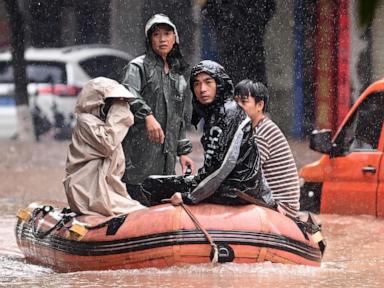
The sky didn't just leak in southern China this week. It broke. Thousands of people have scrambled for higher ground as relentless rain turned streets into rivers and parking lots into underwater graveyards for thousands of cars. This isn't just another seasonal storm or a bad week of weather. We're seeing a fundamental shift in how the Pearl River Delta and surrounding provinces handle extreme climate events, and frankly, the old infrastructure isn't keeping up.
If you're watching the footage of submerged SUVs and residents being paddled away in rubber dinghies, you might think it's a freak occurrence. It's not. The scale of the current evacuations in Guangdong and Fujian provinces reveals a massive vulnerability in one of the world’s most important economic hubs. When the water rises this fast, the economic engine of the region doesn't just stall—it drowns. For a deeper dive into similar topics, we recommend: this related article.
Why the current disaster is different from previous years
Southern China is used to rain. The "Plum Rain" season is a known entity. But what we're seeing now involves a level of intensity that bypasses standard drainage systems. In some cities, a month’s worth of rain fell in just twenty-four hours. That’s not a drainage problem. That’s a physics problem.
The geography of the region makes it a natural bowl. You have high mountains draining into a dense network of rivers that all want to reach the sea through the same narrow outlets. When the sea level is high and the rain is heavy, there’s nowhere for that water to go. It sits. It rises. It destroys. To get more background on this development, comprehensive analysis can also be found on NPR.
Local authorities have raised emergency responses to the highest levels. This isn't just for show. It triggers a massive mobilization of the People’s Liberation Army and local rescue squads. They aren't just moving people; they're trying to save the power grid. Once the substations go underwater, a city of millions goes dark, and that’s when the real panic starts. I've seen how quickly a modern city can revert to a pre-industrial state when the electricity cuts out during a flood. It happens in minutes, not hours.
The staggering cost of submerged assets
While the human cost is the priority, the economic hit is mind-blowing. Let’s talk about the cars. Thousands of vehicles are currently sitting in murky water up to their roofs. In modern EVs and high-end sedans, that’s a total loss. Insurance companies in the region are bracing for a wave of claims that could shatter previous records.
It’s not just the cars you see on the news. It’s the warehouses. It’s the small manufacturing plants in Dongguan and Foshan that produce the world’s electronics and furniture. When a factory floor floods, the precision machinery is often ruined. You can’t just wipe off silt and turn a CNC machine back on. The calibration is gone. The sensors are fried. We’re looking at supply chain ripples that will be felt months from now in retail stores across Europe and North America.
The evacuation logistics nightmare
Moving fifty thousand people in a hurry is a feat of engineering in itself. It’s not just about getting them out; it’s about where they go. High schools, stadiums, and government buildings become makeshift cities.
- Food security: Supplying clean water and hot meals to thousands of displaced people while roads are cut off.
- Medical care: Managing chronic illnesses and potential waterborne diseases in crowded shelters.
- Communication: Keeping the cellular towers powered so families can find each other.
The logistics are messy. People don't want to leave their homes. They worry about looters or their pets. But when the water hits the second floor, the choice is made for them. Rescuers are often working in pitch-black conditions, navigating through floating debris and downed power lines. It’s incredibly dangerous work that rarely gets the credit it deserves.
Infrastructure is failing the modern climate reality
China has spent billions on "Sponge Cities." The idea was to create urban areas that can soak up excess water like a sponge. It’s a great concept. In theory, permeable pavements and urban wetlands should mitigate these disasters.
However, the "Sponge City" initiative was designed for the storms of ten years ago. It wasn't designed for the "once in a century" storms that now seem to happen every eighteen months. We’re seeing a gap between engineering and reality. The concrete jungles of Shenzhen and Guangzhou have replaced natural floodplains. Every square meter of asphalt is another square meter that can't absorb a single drop of rain.
What the data tells us about rainfall intensity
If you look at the meteorological data from the China Meteorological Administration, the trend is clear. The total volume of rain isn't just increasing; the delivery is getting more violent. Instead of a week of steady drizzle, we get a day of torrential downpours.
This creates a "flash" effect. The rivers rise so fast that there’s no time for early warning systems to be effective. By the time the alert hits your phone, the water is already coming through the door. This is a terrifying reality for people living in ground-floor apartments or near riverbanks.
The psychological toll on the survivors
We talk a lot about numbers and infrastructure, but the mental impact is deep. Imagine losing everything you own in three hours. Your car is gone. Your furniture is ruined. Your family photos are pulp.
There’s a specific kind of trauma associated with flooding. It’s the smell. The smell of river silt, sewage, and dampness stays in a house for months. It’s a constant reminder of how vulnerable you are. Many people in southern China are now living in a state of hyper-vigilance. Every time it starts to thunder, they check the river levels. They move their cars to higher ground. They don't sleep.
How to prepare for the next big one
If you live in a flood-prone region, hoping for the best is a losing strategy. You need a plan that doesn't rely on the government or the "Sponge City" working perfectly.
First, get your documents digital. If your house floods, your birth certificates and property deeds shouldn't be in a bottom drawer. Put them in the cloud or on a waterproof USB drive that stays in your "go bag."
Second, understand your local topography. Don't trust the street level. Know exactly where the highest point in your neighborhood is. If you see water beginning to pool on the street, don't wait for an official evacuation order. By then, the roads might be blocked by stalled cars.
Third, look at your insurance. Many people assume they're covered for "acts of God," but the fine print often says otherwise. If you’re in a high-risk zone, you need specific flood coverage that includes your vehicle and your business inventory.
The floods in southern China aren't a localized problem. They're a preview of the challenges every major coastal and river-basin city will face. The water is coming. The only question is whether we'll be ready to swim or just sink. Move your valuables to the top floor. Check your batteries. Don't underestimate the power of a rising river.