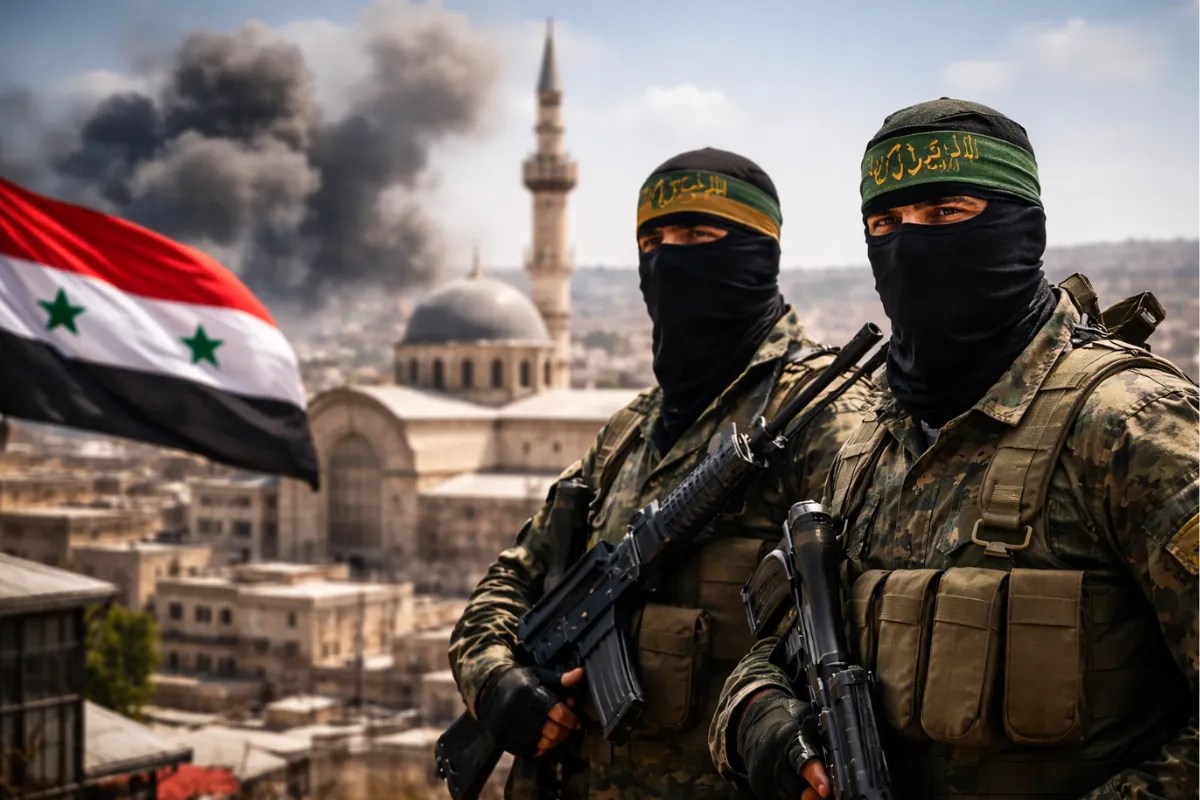
The air in Damascus doesn't just carry the scent of jasmine and exhaust; it carries the weight of a thousand unspoken suspicions. When the thunder of an explosion rolls across the city, residents don't just duck for cover. They look at the sky and begin a silent, frantic calculation. Was it an airstrike? A car bomb? Or, most terrifyingly, was it the sound of a friendship collapsing under the weight of a geopolitical chess match?
The recent strike in the heart of the Syrian capital wasn't just a kinetic event involving high explosives and shattered glass. It was a psychological tremor. Within minutes, the digital arteries of the Middle East were pulsing with a single, toxic narrative: Hezbollah, the long-standing guardian and ally of the Syrian regime, had been betrayed by the very hands it shook. Or worse, that Hezbollah itself had turned its guns inward. Discover more on a related topic: this related article.
The Whisper in the Rubble
Imagine a shopkeeper in the Old City, his hands stained with the dust of centuries. He hears the blast. He knows the geography of his city like the veins on his own palm. He sees the smoke rising from a district where "the friends"—the colloquial term for Hezbollah and Iranian-backed forces—are known to operate. In that moment, the shopkeeper isn't thinking about international law. He is thinking about the terrifying fragility of the ground beneath his feet.
The rumor mill is the most efficient power plant in Damascus. It feeds on ambiguity. The narrative that surged following the strike suggested a "rift in the resistance." It whispered of intelligence leaks from within the Syrian military, pointing fingers at Hezbollah positions to settle old scores or to appease external pressures. It was a story of a house divided. More journalism by The Guardian highlights related perspectives on the subject.
But stories can be weapons.
Hezbollah’s leadership recognized this immediately. They didn't just issue a standard bureaucratic denial; they launched a counter-offensive of rhetoric. Their message was surgical. They didn't just say "we weren't hit by our friends." They said, "Someone is trying to make us kill each other with our eyes closed."
The Architecture of a Frame-Up
To understand the stakes, one must understand the geometry of the alliance. For over a decade, the Syrian government and Hezbollah have been fused by necessity. It is a marriage of iron. However, every long-term partnership develops friction points. There are competing interests, different visions for the post-war era, and the constant, nagging presence of foreign intelligence agencies looking for a crack to drive a wedge into.
The strike in Damascus was designed to be that wedge.
Consider the mechanics of a modern provocation. You don't necessarily need to destroy an entire army to win a war. Sometimes, you only need to destroy their ability to trust the person standing next to them in the trench. If Hezbollah believes the Syrian military is selling their coordinates to the highest bidder, the alliance paralyzes. If the Syrian military believes Hezbollah is operating as a state-within-a-state that invites ruin upon their capital, resentment festers.
Hezbollah’s official statement was a rare moment of baring the throat. By explicitly denying any internal friction and labeling the incident a "conspiracy to incite civil strife," they admitted how close the shadow reached. They weren't just fighting a physical enemy; they were fighting a ghost. A ghost that speaks Arabic and knows their secrets.
The Invisible Stakes of the Damascus Sky
Why does this matter to someone sitting thousands of miles away? Because the Middle East is not a collection of isolated incidents; it is a web. When a thread is pulled in Damascus, the vibration is felt in Beirut, Tehran, Tel Aviv, and Washington.
The "daga" or betrayal narrative is particularly potent in this part of the world. It taps into a deep, historical trauma of being carved up by external powers while internal factions fought over the scraps. By framing the attack as a "dirty trick" by their enemies to cause infighting, Hezbollah attempted to flip the script. They turned a moment of vulnerability into a call for even tighter cohesion.
But logic dictates a harder question: If it wasn't a betrayal, what was it?
The reality of modern warfare in Syria is a chaotic blend of high-tech surveillance and old-school espionage. The sky above Damascus is crowded with the invisible signatures of drones from half a dozen different nations. In such an environment, an explosion is rarely just an explosion. It is a message.
If the goal was to kill a specific commander, the mission might have been a success or a failure. But if the goal was to spark a fire of suspicion between Damascus and its most vital ally, the explosion was merely the starting gun.
The Human Cost of Suspicion
Beyond the geopolitical posturing, there is a human element that the headlines often ignore. There are the families of the victims, caught in a limbo where they don't even know who to blame. There are the young soldiers who now look at their counterparts with a squint of doubt.
Trust is a heavy thing to carry, and it is even heavier to lose. In the aftermath of the strike, the streets of Damascus remained tense. The official denials were broadcast on every screen, but the eyes of the people told a different story. They have seen alliances shift like desert sands before. They know that in this theater, today's savior is often tomorrow's scapegoat.
Hezbollah's insistence that this was an attempt to "make us fight one another" is a recognition of their own precariousness. They are an elite force, but they are operating in a land that is increasingly weary of being a battlefield for everyone else's wars. The narrative of "unity" is a shield, but even the strongest shield can develop hair-line fractures if struck often enough in the same spot.
The Chessboard and the Butcher
We often look at these events as a series of moves on a board. Move: Airstrike. Counter-move: Press release. But this isn't a game. It is a grinding, soul-crushing reality for those living in the shadow of the Qasioun Mountain.
The strike was a reminder that in the modern age, the most effective bomb is the one that explodes inside the mind. If you can make an ally feel like a target, you have won without firing a second shot. Hezbollah is trying to de-escalate the internal panic, but the seed is planted.
Suspicion is a weed that grows in the dark. It doesn't need much water; a little bit of blood will do.
As the smoke eventually cleared over the Damascus skyline, the physical damage was mapped and measured. The glass was swept up. The wounded were treated. But the invisible damage—the erosion of the certainty that the person at your back is actually guarding it—remains.
The "great conspiracy" Hezbollah speaks of may be real, or it may be a convenient cloak to hide deeper, more systemic failures. In the end, it almost doesn't matter. The message has been delivered. In the silence that follows the blast, every handshake in Damascus now feels just a little bit colder, and every glance over the shoulder lingers just a second too long.
The fire is out, but the heat remains, radiating from the bricks of a city that has learned, through bitter experience, that the most dangerous enemy is often the one who calls you brother.