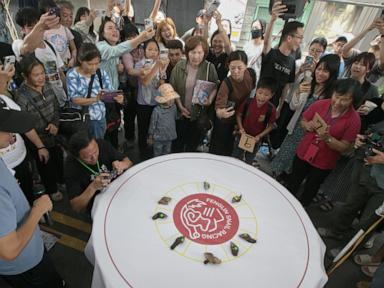
The humidity in Yunlin County doesn't just sit on your skin; it weightily occupies the air, thick with the scent of damp earth and ripening fruit. In the small town of Erlun, the midday sun usually sends residents retreating into the shadows of corrugated metal awnings or the cool tile of living rooms. But today, a group of people is huddled around a wooden plank, their eyes fixed on a starting line. There is no cheering. There are no air horns. There is only the collective, rhythmic breathing of a community watching a gastropod decide which way is north.
We live in a world obsessed with the "fast." Fiber-optic speeds, high-frequency trading, and the frantic scroll of a thumb against glass define our existence. We measure success by the kilometer, the megabit, and the quarterly return. Yet, in this corner of Taiwan, the local residents have decided to bet their afternoon on the African giant snail.
It sounds like a punchline. It is, in fact, a rebellion.
The Slime Trail to Sanity
Consider the African giant snail (Lissachatina fulica). To a farmer, it is a pest that can raze a crop of leafy greens overnight. To a child in Erlun, it is a heavy-shelled gladiator. These creatures move at a top speed of roughly 1 millimeter per second. To complete a 50-centimeter race, a snail must commit to an odyssey. It must navigate the microscopic friction of the wood, the distracting scent of a nearby cabbage leaf, and its own innate desire to simply retract into its shell and sleep.
The rules are deceptively simple. You pick a snail. You place it in the center of a series of concentric circles. The first one to cross the outer ring wins.
But the rules of the race aren't what matter. What matters is the shift in the heart rate of the spectators. You cannot rush a snail. You cannot yell at it to move faster; it has no ears. You cannot motivate it with a whip. You can only wait. In that waiting, the frantic "productivity" of the 21st century begins to dissolve.
A local grandfather, his skin the color of well-oiled teak, leans over the track. He isn't checking his watch. He isn't thinking about the price of rice or the political tensions in the strait. He is watching a trail of silver slime lengthen by a fraction of an inch. He is, perhaps for the first time all week, entirely present.
The Statistics of Stillness
Taiwan is often characterized by its industrial prowess—the semiconductor capital of the globe, a place where precision and speed are the national currencies. The HSR (High-Speed Rail) streaks across the landscape at 300 kilometers per hour, connecting Taipei to Kaohsiung in a blur of efficiency.
Yet, there is a biological cost to this velocity.
Sociologists have long noted that "hurry sickness" contributes to the erosion of community ties. When we move fast, we see the world in low resolution. We see "the neighbor" instead of "Mr. Lin who lost his wife last winter." We see "the commute" instead of the way the light hits the betel nut palms at 4:00 PM.
The snail race is a forced downshift.
Statistically, the snails fail more often than they succeed. Some turn in circles. Some stop entirely. In a typical heat, only a fraction of the participants actually reach the finish line. In any other sporting context, this would be a failure. In Erlun, it’s the point. The "failure" of the snail to perform on command mirrors our own human limitations. We are not machines. We are not meant to produce at a constant, linear rate. Sometimes, we need to retract into our shells.
A Hypothetical Hurry
Let’s look at a character we’ll call Chen. Chen works in a tech firm in Taichung. His life is a sequence of pings.
- 08:00: Slack notification about a bug in the code.
- 12:30: A quick convenience store meal eaten while standing.
- 18:00: An extra shift because the project is behind.
Chen’s nervous system is perpetually stuck in "fight or flight." His cortisol levels are high. His peripheral vision is narrowing. If you sat Chen down in front of a snail race, he would likely be frustrated for the first ten minutes. He would want to poke the snail. He would think about how much "time" he was wasting.
But around the twenty-minute mark, something physiological happens. The parasympathetic nervous system begins to take the wheel. The eyes, tired of the blue light of a screen, begin to track the slow, muscular undulations of the snail's foot. The brain stops scanning for threats and starts noticing details. The spiral pattern of the shell. The way the antennae sensitive to light and touch sweep the air.
Chen realizes that the snail is not "late." It is exactly where it is supposed to be.
The Geography of the Slow Movement
This isn't just a quirky local festival; it is a localized expression of the global Cittaslow movement. Originating in Italy, this philosophy suggests that towns should resist the "homogenization" of the world by preserving local traditions, protecting the environment, and—most importantly—slowing down the pace of life.
Erlun, through its snail races, has tapped into a profound truth about human geography. When a town gathers around something slow, it creates a "thick" social space. You have time to talk. You have time to notice that the person standing next to you has a slight limp, and you ask them about it. You have time to share a slice of watermelon.
The stakes are invisible but immense. The "invisible stake" is the mental health of a generation. By elevating a pest to a protagonist, the townspeople are asserting their right to an unhurried existence. They are reclaiming their attention from the algorithms and giving it to the earth.
The Friction of Reality
It would be a mistake to see this as a purely romantic endeavor. The African giant snail is an invasive species, brought to Taiwan in the 1930s. It represents a history of colonial movement and ecological disruption. It is a creature that carries the weight of its own biology—often carrying parasites that remind us of the raw, sometimes dangerous side of nature.
There is a metaphor here, too. Life is messy. It is slimier than we would like. It carries risks. But when we try to sanitize life by making it fast and digital, we lose the texture.
The snail race is gritty. It’s dirty. It involves bending over until your back aches. It involves the very real possibility that after an hour of waiting, the winner will be determined by a literal hair’s breadth.
Is it a sport? Perhaps not by the definitions of ESPN. But it is a ritual. And rituals are the glue that keeps a society from shattering under the pressure of modernization.
The Architecture of the Afternoon
As the sun begins to dip lower, casting long, golden shadows across the racing board, the tension actually increases. Two snails are nearing the boundary. One, a mottled brown specimen named "Thunderbolt" by a laughing child, has a lead. But "Thunderbolt" has encountered a small splinter in the wood. He pauses. His eyestalks retract slightly.
The crowd leans in. A quiet murmur ripples through the observers.
This is the catharsis. In this moment, the entire world is reduced to a five-centimeter gap. The emails don't matter. The geopolitical tensions don't matter. The only thing that exists is the sheer, stubborn persistence of a creature trying to cross a line.
The snail moves. It doesn't leap; it flows. It pours itself across the finish line with a grace that is only visible if you are willing to look long enough to see it.
The winner doesn't get a million-dollar endorsement. They might get a head of lettuce or just the satisfaction of having chosen the most resolute mollusk in the county. The onlookers stand up, stretch their legs, and begin to drift away. They walk a little slower than they did when they arrived. Their voices are a pitch lower.
We often think of "progress" as a forward-moving arrow, gaining speed until it becomes a blur. But perhaps real progress is the ability to choose your own tempo. Perhaps the most radical thing a person can do in 2026 is to stand perfectly still and wait for a snail to finish its journey.
The wooden board is packed away. The snails are returned to the shade. The silver trails they left behind begin to dry in the evening air, becoming invisible once more, leaving only the memory of a time when the world stopped spinning and simply crawled.