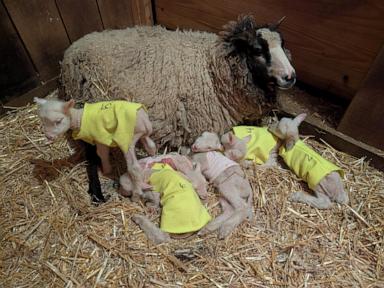
The headlines are dripping with enough sentimentality to drown a pasture. A ewe in Vermont defies the odds. Six lambs born to one mother. It is framed as a miracle, a "one-in-a-million" feel-good story that makes everyone forget, for a fleeting moment, that farming is a cold-blooded business of margins and survival.
Stop smiling. This isn’t a miracle. It’s a biological disaster and a management failure masquerading as a viral moment.
If you’re looking at a photo of six spindly-legged lambs and thinking about "nature's bounty," you’re missing the grim reality of ovine physiology. Sheep weren’t built for this. When we celebrate these freak occurrences, we are cheering for the breakdown of sustainable breeding. We are romanticizing a scenario that usually ends in dead livestock, bankrupted sleep schedules, and a fundamental misunderstanding of what a healthy farm actually looks like.
The Brutal Math of the Ovine Uterus
Standard industry expectations dictate that a healthy ewe should produce twins. One lamb is a wasted opportunity; three is a management challenge; four or more is a crisis.
Sheep have two teats. That is not a suggestion from nature; it is a hard physical limit. The moment a third lamb enters the equation, you are no longer farming; you are running a neonatal intensive care unit. In the Vermont case, we see a "miracle" where the farmer has to step in with bottles, supplemental heat, and 24-hour monitoring.
This isn't productive agriculture. It's an intervention.
When a ewe carries sextuplets, the energy requirements don't just scale linearly—they explode. In the final weeks of pregnancy, the physical volume of those six fetuses compresses the rumen (the largest part of the sheep’s stomach) to the point where she cannot physically consume enough dry matter to meet her metabolic needs.
This leads directly to Pregnancy Toxemia (Twin Lamb Disease). The ewe begins to metabolize her own body fat so rapidly that her liver shuts down under the toxic load of ketones. If you aren't pumping her full of propylene glycol or intravenous glucose, she dies. The "miracle" is actually a high-speed race against organ failure.
The Genetic Debt Nobody Wants to Discuss
The industry has spent decades obsessing over "prolificacy." Breeds like the Romanov or the Finnsheep were brought into commercial flocks specifically to jack up the lambing percentage. We wanted more. We always want more.
But here is the nuance the feel-good articles ignore: Quantity is the enemy of quality.
A single lamb born at 12 lbs is a tank. It hits the ground, finds the teat within minutes, and has the brown fat reserves to survive a cold snap. Six lambs born at 3 lbs each are fragile biological liabilities. Their surface-area-to-mass ratio is a nightmare for thermoregulation. They lack the vigor to compete.
By celebrating the sextuplet outlier, we are validating a breeding philosophy that prioritizes raw numbers over maternal ability. A ewe that can raise two heavy, fast-growing lambs on grass alone is worth ten times more than a "super-mother" who needs a human shadow and a crate of expensive milk replacer to keep her litter alive.
If you have to bottle-feed four out of six lambs, you have lost your profit margin. The labor alone, calculated at any reasonable hourly rate, turns those "miracle" lambs into the most expensive livestock on the planet.
The Survival Bias in Your Newsfeed
The reason you see the Vermont story is because they survived. You don't see the thousands of stories where the ewe drops six underdeveloped fetuses in the mud at 3:00 AM and they are all dead by sunrise. You don't see the ewes that prolapse under the weight of a sextuplet pregnancy and have to be euthanized.
Media outlets love the "rare event" because it fits a Disney-fied narrative of farming. They treat the farm like a petting zoo where more babies equals more happiness.
I’ve seen farmers chase these high-prolificacy numbers only to burn out within three seasons. They spend their entire spring in a state of sleep-deprived psychosis, tube-feeding weak lambs and praying the ewe doesn't go down with milk fever. It’s a grind that rewards nobody.
Efficiency vs. Excess
The "lazy consensus" says that more life is always better. It isn't.
In a world of tightening margins and climate volatility, the future of sheep farming isn't "more babies per ewe." It’s "more pounds of lamb weaned per dollar of input."
The hyper-prolific ewe is a high-maintenance diva. She requires grain-heavy diets to sustain the pregnancy, specialized housing, and constant human intervention. Compare that to a low-maintenance ewe that produces twins, stays on pasture, and requires zero assistance.
- The Prolific Model: High risk, high labor, low per-head vigor, massive supplemental costs.
- The Sustainable Model: Moderate output, zero labor, high vigor, zero supplemental costs.
The Vermont story is a fluke, yes, but it’s a fluke that points toward a dangerous obsession with the extreme. We are losing the middle ground of hardy, self-sufficient animals in favor of genetic anomalies that make for good social media content.
Stop Asking "How Many?" and Start Asking "How Strong?"
When people ask "How many lambs did she have?", they are asking the wrong question. The question should be: "How many did she raise without help?"
If the answer is zero, she isn't a miracle. She’s a failure of selection.
Farming is about the mastery of biology, not the exploitation of it. When we push an animal to its absolute breaking point—where it produces three times the offspring it was designed to support—we aren't "working with nature." We are fighting it.
The Vermont sextuplets aren't a sign of a thriving agricultural sector. They are a warning. They represent the edge of the cliff where biological reality meets human greed for "more."
If you want to support farmers, stop sharing stories about sextuplets. Start looking for the farmers who are breeding for resilience, for mothering instinct, and for the ability to thrive on nothing but sun and soil.
The miracle isn't the ewe that has six lambs she can't feed. The miracle is the ewe that has two, feeds them both, and walks away with her health intact and your bank account in the black.
Kill the sentimentality. Buy the twins. Leave the sextuplets to the circus.