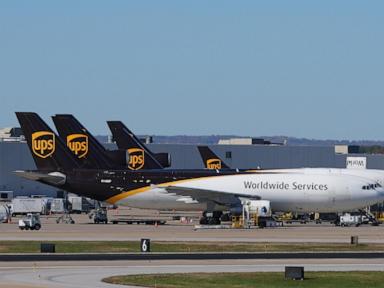
The cockpit of a Boeing 767 is not a place of frantic motion. It is a space of clinical, measured observation. High above the concrete sprawl of an international airport, the pilots of a UPS cargo jet were locked into a rhythm of descent that had been practiced thousands of times. They were heavy. Tons of freight—packages, critical medical supplies, the physical debris of global commerce—pressed down on the airframe. The landing gear was locked. The flaps were set. The runway, a grey ribbon of certainty, waited for them.
Then, the rhythm broke.
In the tower, the air traffic controller’s voice likely spiked in a way that bypasses the ears and goes straight to the nervous system. A small, single-engine plane had wandered into the path of the giant. It wasn't a mechanical failure or a weather event. It was a human error, a ghost in the machine of modern aviation safety.
The Friction of Near Misses
We live in an era of invisible miracles. Every day, tens of thousands of aircraft dance through the sky, directed by a complex web of radar, satellite data, and human intuition. We have become so good at this dance that we forgot the floor is made of glass. When a UPS jet is forced to "go around"—to shove the throttles forward, pull the nose up, and roar back into the sky because another plane is occupying its promised space—it isn't just a technical maneuver. It is a visceral rejection of a disaster that was seconds away from becoming a headline.
Consider the physics. A loaded 767 doesn't just stop. It is a kinetic force of nature. If you are the pilot of that small Cessna or Piper that has accidentally taxied past a hold short line, you are looking at a building-sized wall of aluminum moving at 150 miles per hour toward your cockpit window.
The industry calls these "runway incursions." It is a sanitized term for a terrifying reality. In the last year, these close calls have migrated from the periphery of aviation news to the very center of the conversation. Austin. New York. San Diego. And now, the latest narrow escape.
The Fatigue of the Watchers
Why is this happening? To understand the "why," we have to look past the cockpit and into the dimly lit rooms of Air Traffic Control (ATC) centers. Imagine a job where a 99% success rate means a catastrophe every few days. The people behind the microphones are operating in a system stretched to its absolute limit.
Staffing shortages aren't just HR problems in this world; they are safety vulnerabilities. When a controller is on their sixth ten-hour shift of the week, the crispness of their mental map begins to blur. The small plane on Runway 4 Left becomes a blip that merges with the background noise. The UPS jet, screaming toward the same patch of Earth, is part of a relentless queue that never ends.
The technology we rely on is supposed to be the safety net. Systems like ASDE-X (Airport Surface Detection Equipment) are designed to scream when two objects are on a collision course. But technology is a tool, not a savior. It requires a human to interpret the warning and a pilot to execute the escape. In those seven seconds between the realization of a conflict and the roar of the engines as the UPS crew aborted their landing, the entire multi-billion dollar infrastructure of global aviation rested on the shoulders of two or three people.
The Ghost of Tenerife
Every pilot carries a ghost in their flight bag: the 1977 Tenerife disaster. It remains the deadliest accident in aviation history, caused when two Boeing 747s collided on a foggy runway. It wasn't a mid-air explosion or a wing falling off. It was a communication breakdown on the ground.
Today, we have better radar. We have GPS. We have digital datalinks. Yet, the fundamental risk remains identical. The runway is the most dangerous place in the sky because it is the only place where every flight must eventually go. It is the bottleneck of the entire system. When a small private plane crosses a runway without clearance, they aren't just breaking a rule; they are reintroducing the variables of 1977 into a 2026 environment.
The sheer mass of the UPS jet in this latest incident adds a layer of irony. These cargo flights are the heartbeat of our "next-day" expectations. We want our gadgets, our clothes, and our documents delivered with the speed of a click. That speed is bought with the constant movement of heavy metal through narrow windows of time and space. When that system stutters, the cost isn't just a delayed package. It’s the realization that our convenience is built on a razor’s edge.
The Anatomy of an Escape
When the command to "Go Around" is given, the atmosphere in the cockpit shifts instantly from focused calm to high-energy execution.
- Power: The engines, which were humming at a low approach idle, are slammed forward. There is a lag—a few heart-pounding seconds—before the turbines spool up and the push of the thrust hits the back of the seats.
- Pitch: The nose is pulled up. The view of the runway, and the small plane sitting on it, disappears beneath the dashboard, replaced by the empty, gray sky.
- Clean-up: The landing gear is retracted. The flaps are adjusted. The plane becomes a creature of the air again, shedding the drag that was meant to bring it to a stop.
This maneuver is safe. It is what pilots are trained to do. But it is an admission of a system failure. Every go-around prompted by a runway incursion is a symptom of a deeper malaise in how we manage our crowded skies. We are asking more of our pilots and controllers than ever before, while using a ground-control philosophy that hasn't fundamentally changed in decades.
The Human Factor in a Digital Age
We often talk about "human error" as if it’s a bug to be patched out. In reality, the humans in the loop are the only reason these close calls don't become tragedies. In this latest incident, it was the quick eyes of a controller or the situational awareness of the UPS crew that prevented metal from meeting metal.
But we are testing the limits of that awareness. The complexity of modern airports, combined with the mix of massive commercial jets and small, amateur-piloted planes, creates a volatile chemistry. It is a game of high-stakes Tetris played with lives instead of blocks.
The terrifying part isn't the plane that aborted its landing. The terrifying part is the silence that follows. After the UPS jet climbed back into the clouds and the small plane was directed off the runway, there was likely a moment of quiet on the radio frequency. A collective intake of breath. The realization of what didn't happen.
We tend to measure safety by the number of crashes. We should be measuring it by the number of "almosts." Each close call is a gift—a free lesson that didn't cost a life. But the universe only gives so many gifts before it demands payment.
The grey ribbon of the runway is a promise between the pilot and the ground. It is a promise that the path is clear, that the calculations are correct, and that the world below is ready for the weight of the arrival. When that promise is broken, the shadow of the jet doesn't just pass over the tarmac; it passes over the entire illusion of our absolute control.
The UPS jet eventually landed. The packages were delivered. The small plane went on its way. But somewhere in an FAA office, a data point was logged, adding to a growing mountain of evidence that the dance in the sky is getting too crowded for the dancers to see their own feet.
The engines cool. The pilots walk away. The runway sits empty for a few seconds, waiting for the next heavy soul to drop from the clouds.



