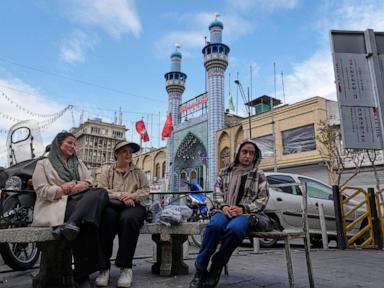
In the Grand Bazaar of Tehran, the air is thick with the scent of saffron, damp wool, and something much more corrosive: uncertainty. You can see it in the eyes of a merchant named Reza. He has sat in the same three-by-three meter stall for thirty years, selling Persian rugs that are effectively woven maps of a culture’s patience. Today, Reza isn't looking at the intricate floral patterns of a Tabriz silk. He is looking at his phone, watching a flickering line chart of the rial's value against the US dollar.
It is a slow-motion car crash.
When the currency drops, the price of the bread he buys for his children climbs before the sun sets. Reza is the human collateral in a geopolitical standoff that resembles a high-stakes poker game played between two men in gilded rooms thousands of miles apart. In Washington, Donald Trump stares across the ocean, convinced that if he just turns the vice one more quarter-turn, the Iranian leadership will snap. In Tehran, the Supreme Leader and his inner circle sit behind thick walls, convinced that if they simply refuse to flinch, the American president will eventually get bored and look for a different fight.
They are both betting with Reza’s life.
The Mathematics of a Breaking Point
To understand why the Iranian leadership thinks they can outlast a superpower, you have to look past the spreadsheets. On paper, the economy is a disaster. Inflation has regularly cleared 40 percent. The oil that once funded the nation’s schools and infrastructure now sits in tankers, unsold or traded in the shadows at deep discounts to bypass sanctions.
But Tehran does not run on Western logic.
The Iranian leadership views the economy through the lens of "Resistance Economy," a doctrine that treats financial hardship not as a failure of policy, but as a test of revolutionary faith. They look at the history of the last forty years and see a record of survival against all odds. They survived a decade-long war with Iraq that saw their cities leveled. They survived the "maximum pressure" campaigns of the past. To them, the current strangulation is just another season of winter. They believe they have built a fortress out of scars.
This creates a dangerous psychological disconnect. While American policymakers see a nation on the verge of collapse, Iranian leaders see a nation in the middle of a marathon. They believe Trump is a transactional actor—a businessman who wants a "deal" to brag about on social media. They suspect that his aggression is a performance, and that if they maintain their stoic defiance, the cost of the conflict will eventually outweigh the benefit for an American administration that is notoriously wary of "forever wars."
The Ghost in the Machine
Consider the ripple effect of a single barrel of oil. In a normal world, that barrel is a commodity. In the current Iranian reality, it is a ghost. To move it, the state has to engage in a complex dance of "dark fleets"—tankers that turn off their transponders, change their names mid-voyage, and transfer their cargo in the dead of night in the middle of the ocean.
This shadow economy has created a new class of power brokers in Tehran. These are the men who know how to move money through the cracks in the global financial system. For them, sanctions are not a burden; they are a business model. When the front door is locked, the man with the key to the back door becomes king. This is the irony of the "blink first" strategy. The very pressure intended to force the government to the table often empowers the most hardline elements within that government—the ones who thrive in the chaos and have the least to gain from a return to international norms.
Meanwhile, the middle class—the teachers, the doctors, the engineers—is being hollowed out. These were the people who were supposed to be the bridge to the West. Now, they are busy figuring out how to trade their savings for gold or iPhones just to preserve a shred of value. They are not thinking about democratic reform or nuclear enrichment levels. They are thinking about meat.
The price of red meat in Tehran has become a more accurate barometer of political stability than any speech given in the Majlis. When a father can no longer afford to put lamb on the table for a Friday dinner, the social contract doesn't just bend. It frays.
The Mirage of the Blink
The fundamental miscalculation on both sides lies in the definition of a "blink."
Trump defines a blink as Iran coming to the table to sign a more restrictive nuclear deal that also limits their missile program and regional influence. He sees his leverage as absolute. $400 billion in lost oil revenue is, in his mind, an argument that no rational leader can ignore. He assumes that because he would want to settle the debt and move on, they must as well.
But the Iranian leadership defines a blink as Trump realizing that the "maximum pressure" campaign has failed to produce a single policy change. They are waiting for the moment the U.S. realizes it is screaming at a stone wall. They are betting on the American electoral cycle, hoping that domestic fatigue or a shift in the political winds will eventually lead to a relaxation of the grip without them having to give up their core identity.
It is a collision of two different types of ego. One is the ego of the dealmaker who believes everything has a price. The other is the ego of the martyr who believes that suffering is proof of righteousness.
The Invisible Stakes
Back in the bazaar, Reza closes his stall early. There are no tourists. The locals are only buying essentials. He walks past a mural on a brick wall—a towering image of a fist clutching a rifle, painted in the vibrant, fading colors of the 1979 revolution.
The mural is peeling.
The danger of this "blink first" stalemate is that it assumes the status quo can be maintained indefinitely. It ignores the "black swan" events—the sudden spark that turns economic frustration into a wildfire. We have seen these sparks before in the streets of Tehran and Isfahan. Each time, the state manages to stomp them out, but each time, the ground is left a little more charred, a little more volatile.
The leadership in Tehran thinks they are playing a game of chicken on a highway. They think they can see the headlights of the American truck coming toward them and that they have the nerves to stay the course. What they fail to realize is that the road beneath them is crumbling. You can't win a game of chicken if the bridge collapses before the two cars even meet.
There is a Persian proverb: "The mountain does not move, but the wind eventually turns it to dust."
The leaders in the high offices are convinced they are the mountains. They are focused on the horizon, watching for the first sign of a flinch from the West. They are so consumed by the spectacle of the standoff that they have stopped listening to the wind.
But the wind is loud in the bazaar. It carries the voices of millions of people who are tired of being the currency in a game they never asked to play. If the "blink" doesn't come soon, there might not be a house left to lead, regardless of who claims victory in the end. The silence of the shops and the empty shelves are not just economic data points. They are the sound of a clock ticking toward a midnight that neither Washington nor Tehran is prepared for.
In the end, it won't matter who blinks first if everyone is left blind.