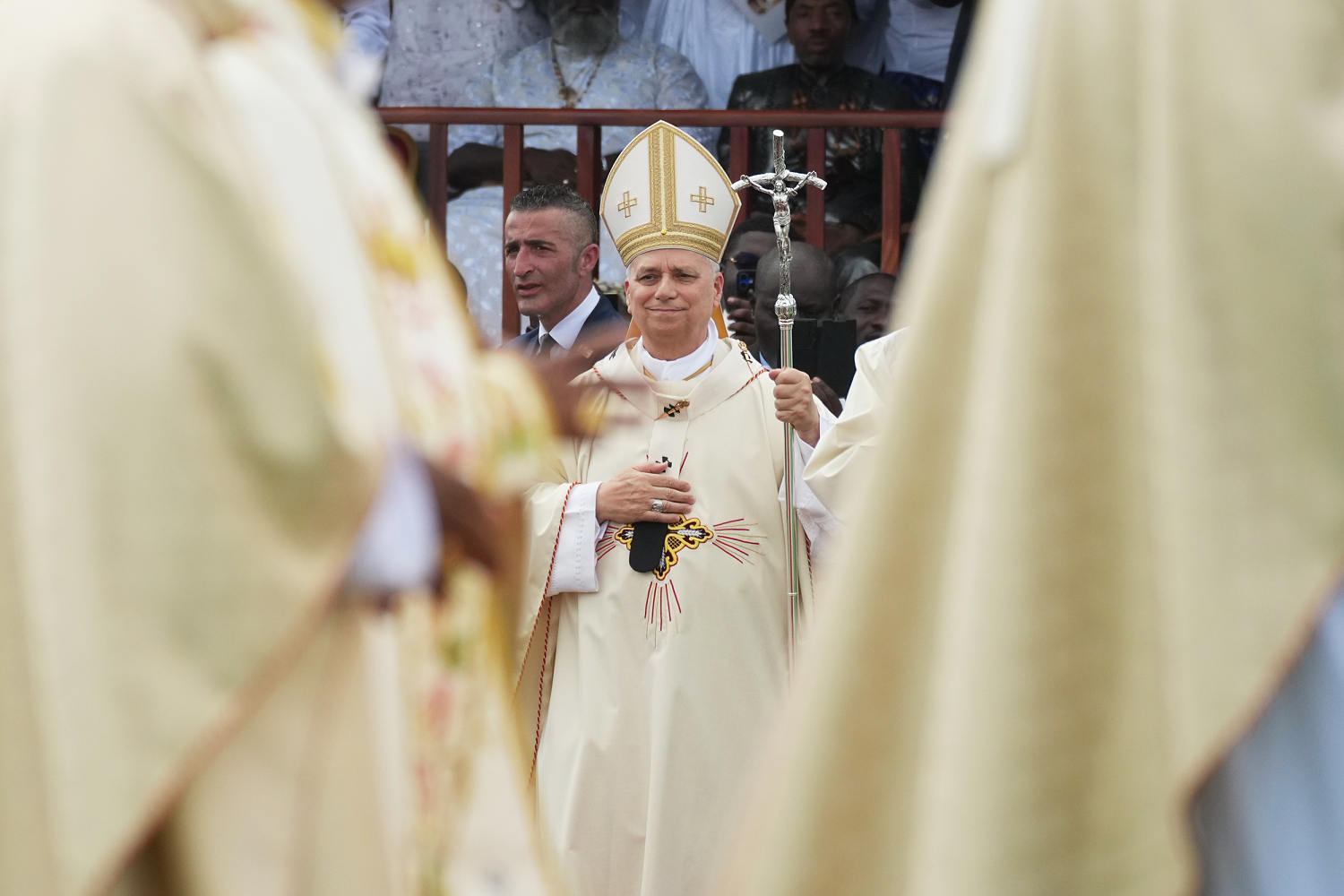
The red dust of Yaoundé has a way of clinging to everything it touches. It settles into the creases of Sunday best shirts, coats the leaves of the mango trees, and hangs in the air like a dry, ochre veil. On this particular morning, that dust rose in great, swirling clouds, kicked up by the feet of 120,000 people. They didn't come for a concert. They didn't come for a political rally. They came to see a man who, in their eyes, carries the keys to both heaven and a fairer slice of the earth.
Pope Leo XIV stepped onto the soil of Cameroon not as a distant monarch, but as a lightning rod for a continent’s exhaustion. For an alternative view, consider: this related article.
The silence that fell over the crowd when he began to speak was heavy. It wasn't the silence of boredom; it was the expectant hush of a people who have spent decades watching their resources leave on ships while their children go to bed with the dull ache of hunger. When the Pope opened his mouth, he didn't reach for the flowery prose of a theologian. He went for the jugular of global economics.
The Arithmetic of Despair
Statistics are easy to ignore when they live on a spreadsheet in Geneva or New York. They become a different beast entirely when you see them reflected in the eyes of a mother standing in a crowd under a bruising sun. Related coverage on the subject has been shared by TIME.
Consider a hypothetical woman named Amara. She is one of the thousands in that 120,000-person sea. Amara works twelve hours a day. She is part of the backbone of an economy that produces cocoa, oil, and timber. Yet, as the Pope noted, the wealth generated by her hands never seems to pool in her village. It flows upward and outward, like water defying gravity, accumulating in the hands of a tiny, distant elite.
Leo XIV called this "the scandal of the surplus."
He spoke about a world where the top one percent holds more wealth than the bottom 99 combined. In the context of Cameroon—and Africa at large—this isn't just a grievance. It is a structural cage. The Pope’s argument was simple: God did not create a world of scarcity; humans created a system of hoarding. He wasn't just preaching gospel; he was delivering a blistering critique of a global financial architecture that treats some humans as assets and others as externalities.
A Voice Against the Gilded Wall
The roar from the crowd when he attacked the "uneven distribution of wealth" was visceral. It was the sound of 120,000 people feeling seen.
For many in the West, "wealth redistribution" is a phrase that triggers debates about tax brackets and social safety nets. In the streets of Yaoundé, it is a matter of basic dignity. It means a road that doesn't wash away in the first rain. It means a clinic that actually has medicine on the shelves. It means a future where the brightest minds of the country don't feel forced to risk their lives on a rubber dinghy in the Mediterranean just to find a job that pays a living wage.
Leo XIV didn't mince words. He described the current economic trajectory as a "new form of colonialism," one that doesn't need soldiers or flags because it uses debt and trade imbalances to achieve the same ends.
He stood there, a small figure in white against the sprawling green hills, and told the world’s power brokers that their ledgers are stained. He argued that a market that values profit over the person is not a free market; it is a predatory one. The crowd leaned in. They knew this truth in their bones long before the Vatican issued a press release about it.
The Invisible Stakes
Why does a religious leader’s take on economics matter so much?
Because economics is, at its heart, a moral story we tell ourselves about what people deserve. If we believe that poverty is a personal failure rather than a systemic design, we can ignore the 120,000 people in that field. We can tell ourselves they just need to work harder, despite the fact that they are already working harder than almost anyone in a London high-rise.
The Pope is trying to flip the script.
He is asserting that the economy should serve humanity, not the other way around. He pointed to the grotesque irony of a world that can move billions of dollars across the globe in a millisecond but takes years to deliver clean water to a rural school. This isn't just about charity. Leo XIV was careful to make that distinction. Charity is a choice; justice is a requirement. He wasn't asking the wealthy to be nice. He was demanding that the system be just.
The Dust Settles
As the ceremony drew to a close, the sun began to dip, casting long, dramatic shadows over the mass of humanity. The Pope moved through the crowd, his white robes a stark contrast to the vibrant patterns of the Cameroonian fabrics.
People reached out just to touch the side of his vehicle. They weren't looking for a miracle in the supernatural sense. They were looking for a champion. In a world that often feels like it has forgotten the "bottom billion," having one of the most recognizable men on earth stand on your soil and shout your truth to the heavens is a form of fuel.
But the real test starts when the plane wheels leave the tarmac.
The Pope’s words were a seed dropped into the red Cameroon earth. Whether that seed grows into a movement or remains a beautiful memory depends on whether the rest of the world was listening, or if they were too busy checking their stock portfolios to hear the cry from Yaoundé.
The 120,000 will go back to their homes. They will return to the markets, the farms, and the small shops. They will carry the red dust on their shoes, and for a little while, they will carry the weight of those words in their hearts. The Man in White spoke. Now, the world has to decide if it has the courage to change the math.
A mother picks up her child and begins the long walk home, the Pope’s voice still echoing against the quiet of the evening: "A world where many starve while few feast is not a world at peace."
The dust lingers. The hunger remains. The question hangs in the air, unanswered and urgent.