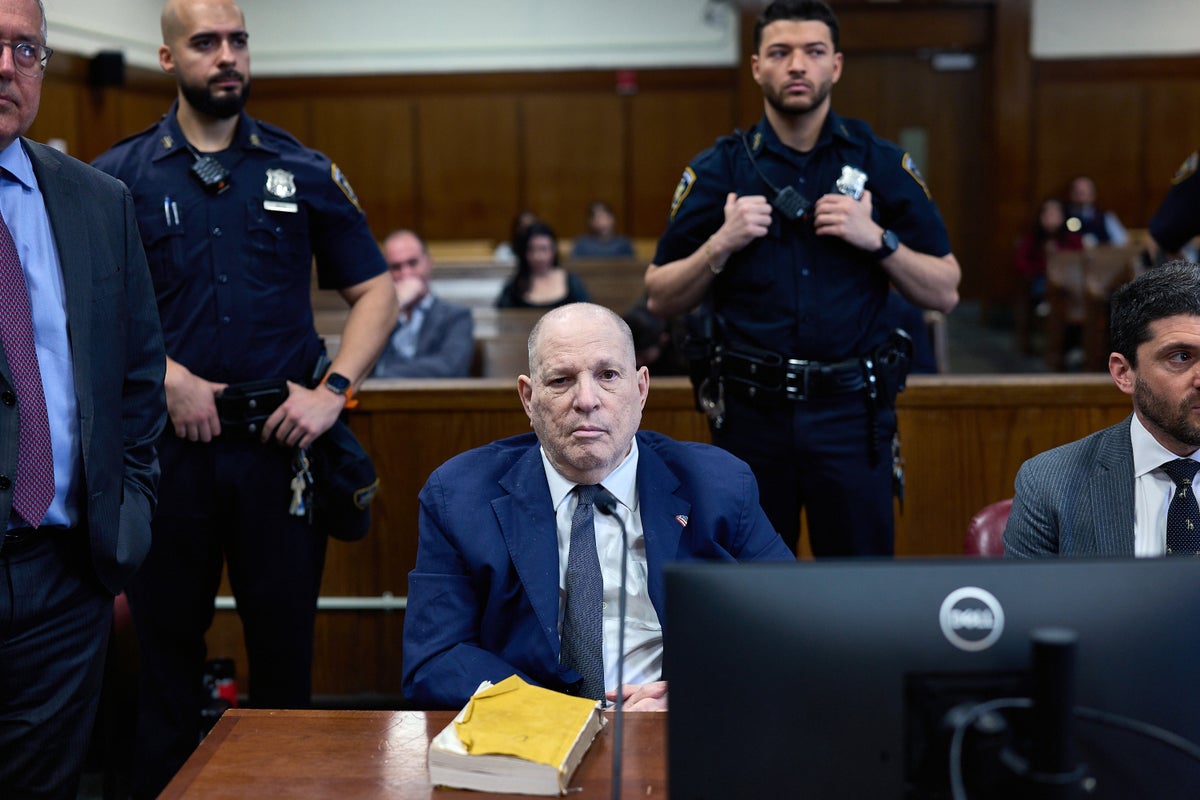
The air inside a Manhattan courtroom has a specific weight. It is thick with the scent of floor wax, old paper, and the frantic, silent prayers of people whose lives have been reduced to dockets and dates. For Harvey Weinstein, this room has become a permanent residence, a final act in a drama he no longer directs.
Once, his name was a barked command that could make or break a career before lunch. Now, it is a whispered case file.
He sits at the defense table, a man defined by the slow, grinding machinery of the New York State judicial system. The headlines call it a "third trial." To the legal teams, it is a matter of procedural chess, of vacated convictions and retrials mandated by the highest courts. But for the women who must walk back into that fluorescent glare, it is something else entirely. It is a haunting that refuses to end.
The Architecture of a Ghost
To understand why we are here again, you have to understand the collapse of the first floor. In 2020, Weinstein was convicted of a criminal sexual act and third-degree rape. It was the shot heard ‘round the world, the moment the dam finally broke. But in April of last year, the New York Court of Appeals tossed that conviction into the furnace.
They didn't do it because he was innocent. They did it because the trial judge allowed prosecutors to call witnesses whose stories weren't part of the actual charges—women who spoke of "prior bad acts." The appeals court ruled this prejudiced the jury, creating a trial of character rather than a trial of specific crimes.
Justice is blind, but it is also obsessively technical.
Now, the state must do it all over again. They must rebuild the house, brick by painful brick, without using the "extra" materials the court deemed illegal. This isn't just a legal rerun. It is a test of endurance. Imagine having to recount the worst thirty minutes of your life to a room full of strangers. Now imagine doing it, winning, and being told four years later that your words didn't count.
You have to do it again.
The Witness and the Clock
Consider a hypothetical woman. Let’s call her Sarah. Sarah isn't a celebrity; she isn't looking for a book deal. She is a professional who carried a secret in a lead box for a decade. When she testified the first time, she felt a sense of purge. She walked out of the building and breathed air that felt, for the first time, clean.
Then the phone rings. The District Attorney’s office is on the line. The conviction is overturned. They need her back on the stand.
The psychological toll of a third trial isn't found in the legal briefs. It’s found in the way Sarah’s hands shake when she sees a black town car. It’s found in the insomnia that returns like an old, cruel friend. The legal system views witnesses as data points, as delivery mechanisms for evidence. It rarely accounts for the fact that every time a survivor speaks, they are bleeding.
The defense knows this. Time is the greatest ally of the accused. Memories blur. Details soften at the edges. A witness who was certain in 2020 might stumble over a date in 2026. A small inconsistency—the color of a rug, the time of a phone call—becomes a crack. The defense team will hammer at that crack until the entire foundation shudders.
The City that Never Forgets
New York is a character in this story. The city’s legal landscape is a labyrinth where cases can wander for years. The Manhattan DA, Alvin Bragg, is under immense pressure. This isn't just about one man; it’s about the credibility of the office. If they fail to secure a conviction this time, the narrative shifts from "justice served" to "systemic failure."
The stakes are invisible but massive.
If Weinstein walks free in New York, the message ripples outward. It suggests that if you have enough resources, you can outlast the truth. You can wait for the world to get bored. You can wait for the witnesses to tire. You can wait for the law to find a loophole large enough to drive a limousine through.
But there is a counter-pressure. A new generation of prosecutors and jurors has grown up in a world where the power dynamics of the 1990s are no longer tolerated. The "casting couch" isn't a Hollywood cliché anymore; it’s a crime scene.
The Weight of the Evidence
This third trial will be leaner. It will be focused. The prosecution can no longer rely on the sheer volume of "bad act" witnesses to paint Weinstein as a predator. They have to prove specific instances of force and lack of consent with surgical precision.
They are looking at the 2006 encounter with a production assistant and the 2013 rape of an aspiring actress. These are the pillars. If they hold, the legacy of the movement remains intact. If they crumble, we enter a period of profound uncertainty.
The courtroom drama is often portrayed as a battle of wits between high-priced lawyers in Italian wool suits. It’s a compelling image, but it’s a lie. The real battle is happening in the silence between the questions. It’s in the eyes of the jury as they look at a man who was once a god of the silver screen and see only a frail octogenarian in a suit that no longer fits.
Is he a villain? A scapegoat? A relic?
The jury doesn't get to decide who he is. They only get to decide what he did on two specific nights, years ago, in rooms where no one else was watching.
The Echo Chamber
Outside the courthouse, the world has moved on to newer scandals and fresher outrages. The "Me Too" era is often spoken of in the past tense, as if it were a fever that broke. But inside the room, the fever is still burning.
The defense will argue that these were consensual encounters, part of the "transactional nature" of the industry. They will paint the victims as opportunists who only felt regret once the wind changed. It is an old strategy, a classic play from a tired playbook, but it only has to work once.
The prosecution, meanwhile, is fighting the ghost of the previous trial. They have to be better. They have to be tighter. They have to ensure that this time, there is no room for an appellate court to find a flaw.
There is a grim irony in the fact that the very protections meant to ensure a fair trial for the innocent are the same ones that provide a lifeline for the monstrous. This is the paradox of our system. We would rather see a guilty man go through three trials than see one innocent man denied his rights. It is a noble principle that feels devastating in practice.
The Last Frame
As the trial begins, the cameras will swarm. The pundits will dissect every motion. But the real story isn't in the legal jargon or the political posturing.
The story is in the hallway.
It’s in the woman standing outside the double doors, taking one last deep breath before she walks into the lion’s den for the third time. She knows that even if she wins, she doesn't get those years back. She knows that her name will forever be linked to his in the digital amber of the internet.
She walks in anyway.
Harvey Weinstein watches her enter. He is a man who spent his life creating fiction, crafting narratives that made people weep and cheer in the dark. But here, in this cold light, he has lost control of the script. The ending is no longer his to write.
The gavel falls. The room goes silent. The ghost is back on the stand.