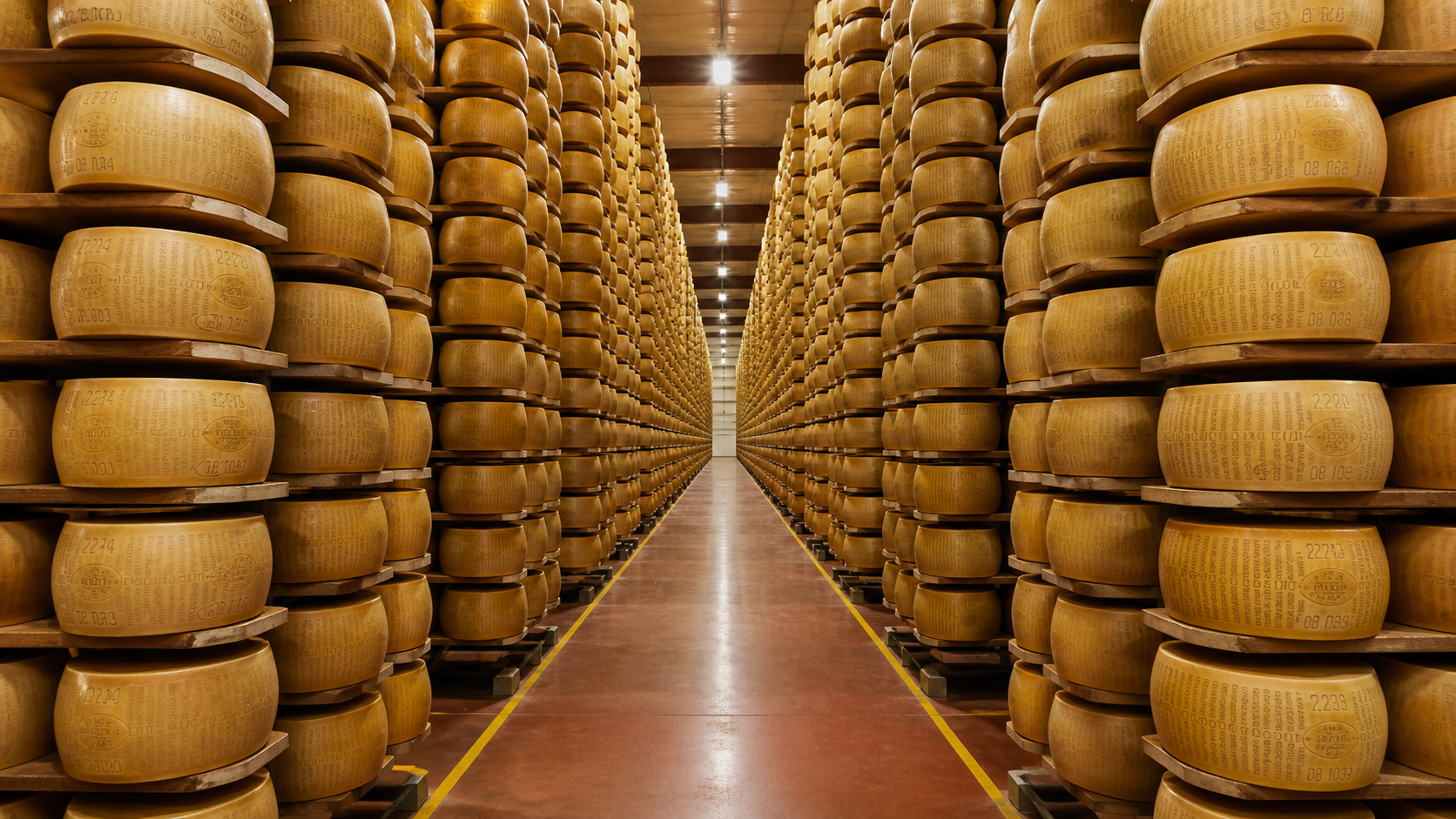
You've probably heard about the traditional banking systems holding gold bars in secure, heavily guarded subterranean vaults. But what if I told you that in northern Italy, a bank's most valuable asset smells like a high-end delicatessen?
Credito Emiliano, widely known as Credem, stores roughly 430,000 wheels of Parmigiano Reggiano in heavily secured, climate-controlled warehouses. These wheels are worth around €190 million, and they serve a highly practical financial purpose. This system is not a fun novelty or an eccentric PR stunt. It's an absolute lifeline that props up a €4 billion industry. In similar updates, take a look at: The Forced Optimism of Chinas May Day Spending.
Let's break down why this happens and what it means for small producers trying to survive in a volatile modern economy.
The Brutal Cash Flow Problem Behind the Cheese
Producing authentic Parmigiano Reggiano isn't a fast operation. It is an artisanal craft bound by strict, unyielding laws. The Economist has provided coverage on this fascinating issue in extensive detail.
Under the stringent regulations of the Protected Designation of Origin (PDO) status, this hard cheese can only be crafted in specific provinces, including Parma, Reggio Emilia, and Modena. The recipe uses only three ingredients: raw milk, salt, and rennet.
To produce a single 40-kilogram (roughly 90-pound) wheel, you need about 550 liters of milk. The financial burden doesn't stop at the raw ingredients. The aging process takes a minimum of 12 months, and many producers hold their wheels for 24, 36, or even 40 months to reach optimal flavor profiles.
During this extended maturation period, the producer is spending money every single day. They pay for labor, equipment maintenance, and cattle feed. But until the wheel hits the market, there's absolutely no incoming revenue from that batch.
Imagine having hundreds of thousands of dollars tied up in inventory that you cannot sell for two years. That's the daily reality for roughly 300 dairies and 2,000 farmers operating in the region.
How the Cheese Vault System Works
To solve the liquidity gap, Credem stepped in decades ago. The bank has operated this program since 1953, and it's built on a remarkably simple premise.
When a producer needs working capital, they deposit their young cheese wheels into a specialized, climate-controlled warehouse operated by the bank's subsidiary, Magazzini Generali delle Tagliate.
- The Deposit: The wheels are scanned, tagged, and placed on wooden shelves where temperature and humidity are tightly controlled.
- The Valuation: The bank assesses the current market value of the cheese. They issue a loan covering 60% to 80% of that value.
- The Care: While in storage, the bank takes care of the inventory. They clean, turn, and inspect the wheels, checking for any defects.
- The Return: Once the aging process is complete and the Parmigiano Reggiano Consortium conducts its rigorous tapping test with a hammer, the cheese is cleared for sale. The producer sells the wheel, pays off the low-interest loan, and keeps the remaining profit.
This mechanism protects small-scale producers against wild market fluctuations. Since the price of luxury cheese can swing rapidly depending on global economic conditions, the 60% to 80% loan-to-value ratio acts as a critical safety net.
Why the System Thrives in 2026
You might wonder why a bank would want a warehouse full of perishable dairy instead of standard collateral like real estate or securities. The secret lies in the unique nature of the product itself.
Unlike most goods that depreciate over time, a high-quality wheel of Parmigiano Reggiano actually increases in value as it ages. The market price for a 36-month-aged wheel is significantly higher than a 12-month-aged wheel. The aging process functions similarly to interest accruing on an asset.
Furthermore, the demand for this iconic product remains incredibly resilient. In 2025, exports surpassed domestic sales for the first time, accounting for over 50.5% of total sales worldwide. International demand grew by 2.7%, with strong increases in markets like Spain, Sweden, and the UK.
However, the industry faces real challenges. High inflation has caused domestic sales within Italy to dip by roughly 10%, and producers are wary of pricing themselves out of the market, especially with competition from cheaper substitutes like Grana Padano.
To keep operations running smoothly in this environment, new blockchain technologies are emerging to allow producers to secure loans on cheese stored directly at their own farms, rather than relying exclusively on centralized bank vaults.
Practical Steps for Traditional Asset-Backed Lending
If you are looking at this model from a broader business perspective, the underlying concept is highly applicable to other slow-growth, high-value agricultural sectors.
- Identify Illiquid Assets: Determine if your business holds high-value inventory that requires a long lead time before final sale.
- Standardize Quality Control: You must have a clear, objective grading system. The Parmigiano Reggiano Consortium uses an official fire-branded seal to guarantee quality before any financial leverage is applied.
- Mitigate Storage Risks: Partner with specialized logistics providers who can ensure the environment preserves and enhances the value of the asset.
Ultimately, the marriage between traditional banking and artisanal cheese proves that collateral doesn't have to be digital or metallic to hold real financial weight.