The door to Number 10 Downing Street is black, glossy, and heavy. It does not have a keyhole on the outside. To enter, you must be vetted, searched, and ultimately, welcomed. Inside those walls, power isn't just about the laws that are signed or the speeches given at the dispatch box; it is about the quiet conversations in the corridors. It is about who gets to sit in the room when the most difficult decisions are made.
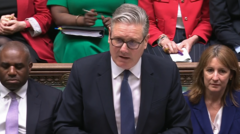
When Keir Starmer stood before the microphones to address the latest murmurings regarding Matthew Doyle, he wasn't just answering a question about a job application. He was defending the sanctity of that inner circle. The facts are deceptively simple: Number 10 officials made inquiries about a civil service role for Doyle, a long-term aide and the Prime Minister’s director of communications. On the surface, it looks like a standard HR query. Beneath that surface, it touches on the ancient tension between political loyalty and the impartial machinery of the British state.
Power is a hungry thing. It demands people you can trust.
The Architect of the Message
To understand why this inquiry matters, you have to look at Matthew Doyle himself. He isn't a face most voters would recognize in a lineup. He is the man behind the man. Doyle has been the steady hand on the tiller of the Labour party’s communications for years, navigating the choppy waters of an election campaign that saw the party swing from the wilderness back into the heart of government.
He is the architect of the narrative. When the Prime Minister speaks, the rhythm of those words often bears Doyle’s fingerprints.
In the high-pressure cooker of Downing Street, the line between a "political advisor" and a "civil servant" can feel like a thin wire stretched across a canyon. A political advisor is there to win. They are there to ensure the party stays in power. A civil servant, by contrast, is there to serve the office, regardless of who holds the keys. They are the permanent memory of the nation. When the two roles begin to blur, the public starts to worry about the "politicization" of the state.
Keir Starmer’s admission that his office "asked about" a civil service role for Doyle wasn't a confession of a crime. It was a glimpse into the logistical headache of a new government trying to reward its most faithful soldiers while staying within the strict, often suffocating rules of the British bureaucracy.
The Ghost in the Machine
Consider a hypothetical staffer—let’s call her Sarah—who has worked in the Treasury for fifteen years. She has served three different Prime Ministers from two different parties. Her loyalty isn't to a person; it’s to the spreadsheet. She ensures the numbers add up so the country doesn't go broke. Now, imagine Sarah hears that a political appointee, someone who spent the last year attacking the very policies she was tasked with implementing, might be "parachuted" into a senior, permanent role right next to her.
The tension isn't personal. It’s structural.
The Civil Service is supposed to be a meritocracy, a place where you climb the ladder through competence and neutrality. When inquiries are made about specific individuals for specific roles from the very top of the hierarchy, it sends a ripple through the entire building. It suggests that the "fast track" isn't about what you know, but who you’ve spent your late nights with on the campaign trail.
Starmer insisted that everything was done by the book. He noted that "no appointment was made" and that "due process" is the North Star of his administration. Yet, the mere act of asking carries weight. When the Prime Minister’s office asks a question, it isn't just a query. It’s an atmospheric shift.
The Cost of the Inner Circle
We often talk about government as a series of cogs and gears. We use words like "administration" and "infrastructure," which make it sound like a cold, metallic thing. It isn't. It is a collection of egos, anxieties, and fierce loyalties.
When a leader enters Number 10, they are surrounded by the people who helped them get there. These are the people who saw them at 3:00 AM in a rainy service station during the campaign. These are the people who protected them from scandals and sharpened their arguments. Naturally, a leader wants these people by their side when the real work begins.
But the British system is designed to resist this impulse. It is built to ensure that even the most powerful person in the country cannot simply populate the government with their friends. This resistance is what we call "checks and balances," but to a Prime Minister trying to fix a broken country, it can feel like sand in the engine.
The Matthew Doyle situation is a symptom of this friction. The government needs Doyle’s expertise. He knows the Prime Minister’s mind better than anyone. But the "permanent" civil service is a guarded fortress. To turn a political operative into a civil servant is to change the DNA of the role.
The Shadow of the Past
Starmer is acutely aware of the ghosts that haunt Downing Street. He spent his career in the law, a world governed by rules, evidence, and the perception of propriety. He knows that his predecessors were often accused of playing fast and loose with these very boundaries. He knows that the public's trust in the "purity" of the civil service is at an all-time low.
By admitting that the inquiry took place, Starmer attempted to perform a delicate surgery. He wanted to be transparent without appearing guilty. He wanted to acknowledge the value of his team without admitting to cronyism.
But transparency is a double-edged sword. It clears the air, but it also reveals the dust motes dancing in the light.
The inquiry about Doyle suggests a government that is still trying to figure out how to transition from the "war room" of a campaign to the "cabinet room" of a nation. In a campaign, loyalty is the only currency that matters. In government, that currency is devalued by the need for objective, often uncomfortable truth. A civil servant’s job is frequently to tell the Prime Minister "No." A political aide’s job is almost always to figure out how to say "Yes."
The Human Toll of the Headline
Beyond the political fallout, there is a human element to this story that rarely makes the front page. Matthew Doyle is a professional. He has a career, a reputation, and a life. To have your name dragged through the press as a potential "crony" is a heavy price to pay for years of service.
It highlights a fundamental flaw in how we treat the people who run our country. We demand total brilliance and total loyalty, but we offer very few clear pathways for that talent to transition into the long-term service of the state. We end up with a "revolving door" that everyone complains about, yet no one knows how to lock.
If Doyle had been appointed, he would have been under a microscope from day one. Every brief he wrote, every meeting he chaired, would have been scrutinized for political bias. In trying to secure his future, the office may have inadvertently complicated his present.
The Weight of the Door
When that black door at Number 10 shuts, the world outside disappears. The noise of the protesters in Whitehall fades to a dull hum. Inside, the air is thick with the history of people who tried to change the world and people who tried to stop them.
The inquiry into Matthew Doyle’s role is more than a footnote in a week of news. It is a reminder that the way we staff our government is just as important as the policies that government produces. If we lose the distinction between the politician and the practitioner, we lose the steadying influence of the state.
Starmer’s defense is that he is a man of the rules. He is betting that the public will see this as a minor administrative hiccup, a moment of "checking the boxes" that ultimately led nowhere. But for those who watch the gears of power turn, it is a signal. It tells us that even the most legally-minded leaders feel the pull of the inner circle. It tells us that the struggle to keep politics out of the machinery of state is a battle fought every single day, often in the smallest of inquiries.
The black door remains closed. The inquiries continue. The line between friend and official remains as thin and as vital as ever. It is a line that, once crossed, is almost impossible to redraw. For now, the Prime Minister has admitted to looking at the line, perhaps even toeing it, but he insists he knows exactly where it sits. The rest of the country is left to watch the door and wonder who is truly standing behind it.