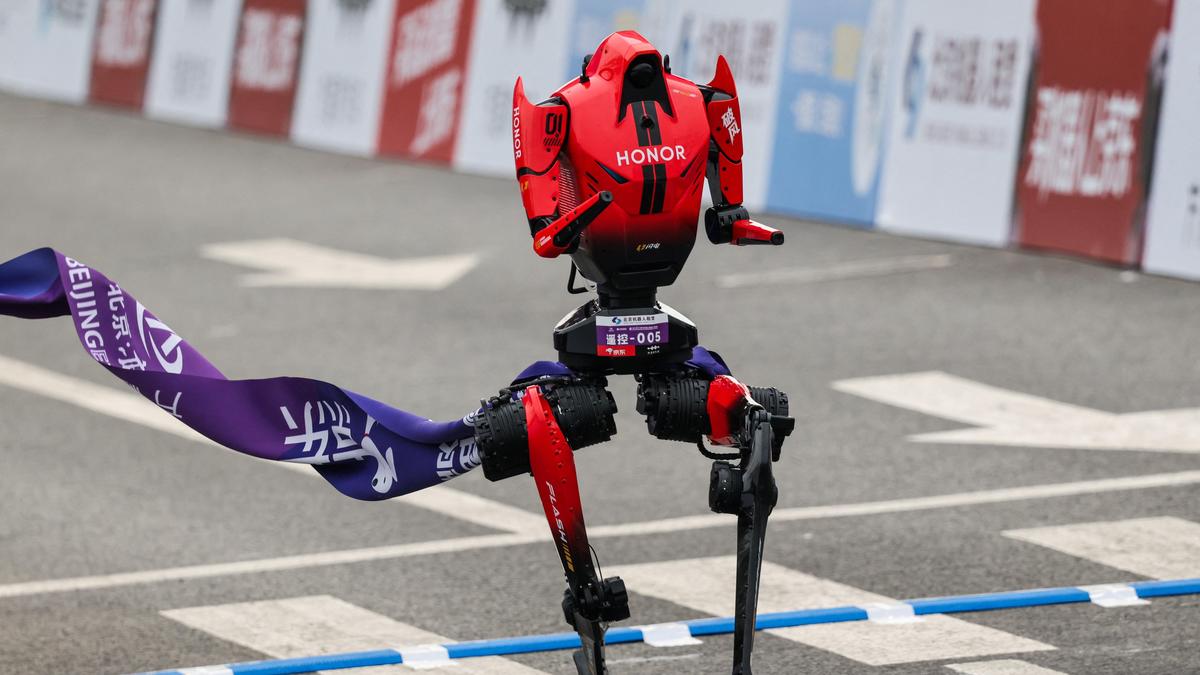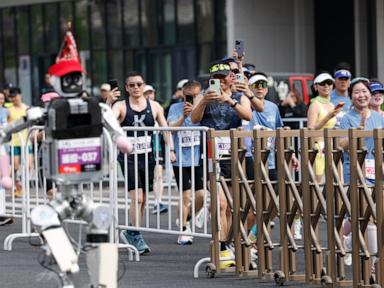
The Tiangong humanoid robot just did something that should make every marathon runner sweat. It didn't just walk or shuffle across a finish line in Beijing. It ran. In fact, it "sprinted" into the history books by clocking a time that technically crushes the current human half-marathon world record. We’re used to seeing robots do backflips in controlled labs or stumble over doorframes in viral blooper reels, but this is different. This was a sustained, high-speed athletic performance in a real-world environment. It’s a massive shift in what we thought machines were capable of doing with two legs.
If you think this is just another tech demo, you’re missing the point. For years, the "bipedal locomotion" problem was the graveyard of robotics. Keeping a heavy metal frame balanced on two sticks while moving at high speeds is a nightmare of physics. Humans do it with millions of years of biological fine-tuning. Tiangong did it with sensors, actuators, and a lot of code. This wasn't a slow-motion walk. It was a 1:02:15 finish for a half-marathon distance. To put that in perspective, the average fit human takes about two hours. The elite world record for humans is currently 57:30, held by Yomif Kejelcha. Tiangong is right on the heels of the fastest people to ever live.
The engineering behind the Tiangong sprint
Tiangong isn't a clunky toy. Developed by the Beijing Humanoid Robot Innovation Center, this machine stands about 163 centimeters tall and weighs around 43 kilograms. It's lean. Most robots are bogged down by heavy batteries and thick steel plates, but Tiangong uses lightweight materials and high-torque density motors to achieve a power-to-weight ratio that actually allows for running.
The secret isn't just the hardware. It's the "brain-like" perception system. Most robots struggle with uneven ground. A tiny crack in the pavement or a slight incline can send a million-dollar machine crashing to the asphalt. Tiangong uses a combination of 3D vision sensors and high-precision Inertial Measurement Units (IMUs). It basically "feels" the ground and adjusts its center of gravity thousands of times per second. I’ve seen enough robots fail to know that this level of stability at high speed is nothing short of incredible.
Why legs beat wheels in the real world
You might ask why we bother with legs at all. Wheels are faster, right? On a smooth warehouse floor, sure. But the world isn't a warehouse. It’s full of stairs, curbs, debris, and narrow paths. If we want robots to actually help us in our homes or on construction sites, they need to navigate the world we built for ourselves. We built that world for beings with two legs.
Tiangong proved that a bipedal design can handle the vibration and impact of a long-distance run. Every time a foot hits the pavement, a massive amount of kinetic energy travels up the leg. In a human, our tendons and muscles act as springs. Tiangong uses specialized "elastic" actuators that mimic this biological function. It’s not just moving; it’s recycling energy. That's how it managed to keep up a pace that would leave 99% of the population gasping for air.
Dealing with the heat and battery drain
Running a half-marathon is a thermal management disaster. Humans sweat to keep from redlining. Robots have it worse. Electronic components generate heat, and high-speed movement causes friction in the joints. Tiangong’s cooling system had to work overtime during the Beijing run to ensure the processors didn't throttle or melt.
Then there’s the battery. Pushing a 43kg frame at world-class speeds for over an hour requires an immense amount of "juice." Most humanoid robots have a battery life that’s frankly embarrassing—usually around 20 to 30 minutes of light activity. The fact that Tiangong finished the distance shows that we’re finally seeing a breakthrough in energy density or, more likely, extreme efficiency in how the motors draw power. They’ve trimmed the "fat" from the movement patterns, ensuring no energy is wasted on unnecessary swaying or jerky motions.
What this means for the future of work and sports
I don't think we’re going to see robot-only Olympics anytime soon, but the line is blurring. When a machine can outrun a human pro, it changes our perspective on "physical" labor. We often hear that AI is coming for the white-collar jobs, but Tiangong shows that the blue-collar, high-mobility jobs are also in the crosshairs.
Think about search and rescue. A robot that can run a 1:02 half-marathon can reach a victim in a disaster zone much faster than a human team carrying heavy gear. It doesn't get tired. It doesn't need to catch its breath. It just goes. This Beijing run wasn't about winning a trophy; it was a stress test for the next generation of utility machines.
The dark side of robotic speed
We have to be honest about the implications. Speed and agility are great for delivery bots, but they’re also the primary requirements for autonomous weaponry. A robot that can navigate a city at 20 kilometers per hour is a formidable platform. While the Beijing team focuses on the "spirit of sport," the underlying tech is dual-use. The same balance algorithms that keep Tiangong upright on a race track can keep a bot upright while carrying a payload in a conflict zone. It's a reality we can't ignore while we marvel at the lap times.
How Tiangong compares to Boston Dynamics
Everyone loves Atlas. The Boston Dynamics videos are legendary. But Atlas is often "choreographed" for short bursts of intense activity. What Tiangong did was a marathon, not a sprint—well, a high-speed sustained run. It showed endurance. While Atlas is the gymnast of the robot world, Tiangong is the long-distance specialist.
The Beijing team took a different approach to the "walking" gait. If you watch the footage, Tiangong has a very distinct, almost "bird-like" leg movement. This lowers the impact on the hips and keeps the head—where the sensors live—as stable as possible. It’s a masterclass in functional design over aesthetic mimicry. It doesn't look exactly like a human runner, and it shouldn't. It’s better.
Stop worrying about the "Terminator" and look at the logistics
People love to jump to sci-fi nightmares, but the immediate impact is going to be much more boring—and much more useful. We’re looking at the "Last Mile" delivery problem being solved. Imagine a fleet of Tiangong-derived bots that can hop out of a van, sprint up a flight of stairs, and drop a package at your door in seconds. No more "sorry we missed you" notes because the driver couldn't find parking.
The data gathered from this Beijing run is a goldmine for developers. They now have an hour's worth of high-fidelity telemetry on how a humanoid handles real-world pavement, wind resistance, and temperature fluctuations. This data will be used to train neural networks in simulation, making the next version even faster and more stable.
Practical takeaways from the Beijing record
If you're following the robotics space, keep your eyes on the "Open-Source" movement in China. The Beijing Humanoid Robot Innovation Center has been vocal about sharing certain parts of their tech stack to accelerate the industry.
- Watch the gait: Notice how the robot's knees stay slightly bent. This is key for shock absorption.
- Sensor fusion: The way it handles shadows and bright light while running is a massive leap for computer vision.
- Weight distribution: Notice how little the upper body moves. All the work is in the "core" and legs.
The "human record" for a half-marathon is still safe for a few more months or years in the official books, but the "bipedal record" belongs to the machines now. This isn't a fluke. It's the new baseline. If a robot can run 21 kilometers today, it'll be doing a full marathon by next year. We’re witnessing the end of human physical superiority in real-time.
Get used to seeing these things on the sidewalk. They aren't just coming; they're already running past you. You should probably check the specs on the next generation of electric actuators if you want to understand how this happened so fast. The hardware caught up to the software, and now the race is truly on.