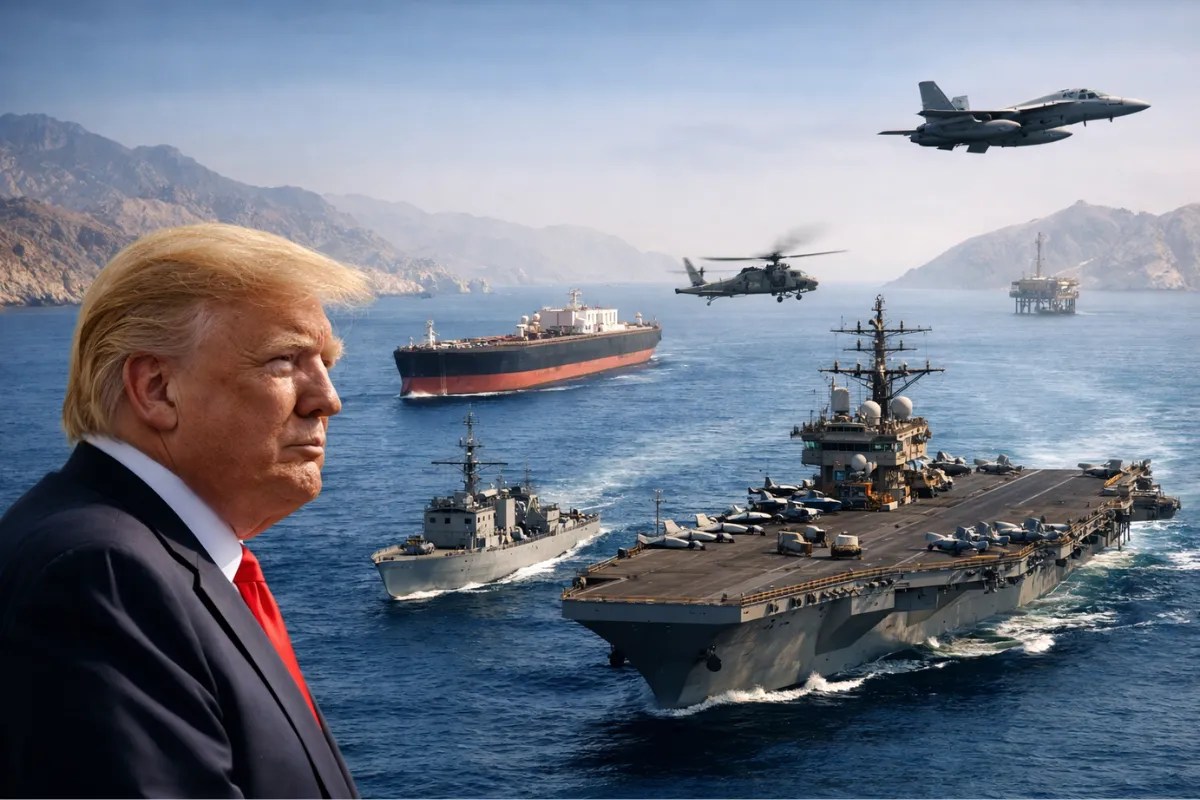
The headlines are screaming about a "failed dialogue" and Donald Trump’s threats to blockade the Strait of Hormuz. It is the same tired script we have seen for decades. The media plays the part of the breathless herald, and the public plays the part of the panicked consumer. Most "analysts" will tell you that a blockade is the ultimate nuclear option for the global economy. They are wrong.
A blockade of the Strait of Hormuz is not a military strategy; it is a psychological one. And quite frankly, the United States is more terrified of the threat of a blockade than the actual event. If the U.S. military actually moved to "shutter" the strait, or if they allowed Iran to do so, they would be dismantling the very dollar-denominated global trade system they have spent eighty years defending.
Trump knows this. Tehran knows this. The only people who don't seem to get it are the ones writing the op-eds.
The Mathematical Impossibility of a Total Blockade
Let’s look at the geography. The Strait of Hormuz is roughly 21 miles wide at its narrowest point. That sounds small until you realize that the shipping lanes—the actual deep-water paths where the VLCCs (Very Large Crude Carriers) travel—are only about two miles wide in each direction, separated by a two-mile buffer zone.
The common "lazy consensus" is that you can just sink a few ships and plug the hole. This is a fantasy. The strait is not a narrow canal like Suez; it is a massive body of water. Sinking a ship in a two-mile wide lane does not stop traffic; it creates a temporary navigational hazard.
To actually "block" the strait, the U.S. Navy or the Iranian Revolutionary Guard would need to maintain constant, lethal kinetic presence over hundreds of square miles. The sheer volume of ordinance required to stop every tanker is staggering. Furthermore, the modern global economy is built on insurance, not just oil. A blockade "happens" the moment Lloyd’s of London decides the risk premium is too high to insure a hull. Trump isn't threatening to sink ships; he is threatening to make the cost of moving them so high that the market chokes itself.
The Petro-Dollar Trap
The U.S. does not need the oil from the Persian Gulf. Thanks to the Permian Basin and the shale revolution, the U.S. is a net exporter. So why the obsession?
It is about the Petrodollar.
If oil stops flowing through Hormuz, the price of Brent crude doesn't just go up; the mechanism of global currency exchange breaks. Most of that oil is headed to China, India, and Japan. If the U.S. blocks the strait, they aren't just hurting Iran; they are declaring economic war on their own creditors.
I’ve spent years watching energy markets react to these "threats." Every time a politician mentions Hormuz, speculators make a killing, and the average person pays five cents more at the pump. The threat is the product. Trump’s "threat" is a tool to force regional players—specifically Saudi Arabia and the UAE—to pick a side and increase their own production to offset the "risk" he is creating out of thin air.
Why a Blockade Would Be a US Logistics Nightmare
If the U.S. military actually attempted to "start a blockade" as the competitor article suggests, they would face a logistical humiliation.
- Asymmetric Vulnerability: Iran doesn't need a carrier group. They have thousands of fast-attack craft and midget submarines. In a confined space like the strait, a multi-billion dollar destroyer is a giant target for a $50,000 swarm of drones or a "suicide boat."
- Mine Warfare: The U.S. Navy is notoriously thin on mine-sweeping capabilities. Iran can dump thousands of "dumb" bottom-moored mines in the water in a single night. Clearing those takes months.
- The Insurance Spike: The second a shot is fired, shipping insurance rates would jump 500% to 1000%.
Trump’s rhetoric ignores these tactical realities because he isn't talking to generals. He is talking to the markets. He is trying to "jawbone" the price of oil into a position that suits his domestic agenda.
The "Negotiation Failure" Fallacy
The competitor article claims the blockade threat comes because "talks failed." This is a fundamental misunderstanding of how high-stakes diplomacy works. Talks didn't "fail." The friction is the point.
In any negotiation involving the Iranian plateau, the goal isn't a signed piece of paper; it’s a shift in the regional balance of power. By threatening a blockade, the U.S. is signaling to the global community that it still holds the "kill switch" for the global economy. It is a desperate attempt to maintain relevance in a world that is increasingly looking for ways to bypass the dollar.
Imagine a scenario where the U.S. actually closes the strait. China immediately activates the "Belt and Road" pipelines that bypass the water entirely. Russia ramps up its land-based exports. The U.S. would essentially be forcing its rivals to perfect their "dollar-free" infrastructure.
The Brutal Truth About "Energy Independence"
We are told that the U.S. is "energy independent," yet we are still held hostage by a 21-mile strip of water on the other side of the planet. This is the great lie of modern energy policy.
As long as oil is priced in a global market, "independence" is a myth. If the price of oil hits $150 a barrel because of a skirmish in the Gulf, American consumers will pay $150-equivalent prices, regardless of whether that oil came from Texas or Tehran.
Trump’s threat is an admission of weakness, not a show of strength. If the U.S. were truly independent and powerful, the Strait of Hormuz would be an irrelevant geographical footnote. Instead, it remains the jugular of the American empire.
Stop Asking if the Strait Will Close
The question isn't "Will they close the strait?" The question you should be asking is "Who benefits from the fear that it might close?"
- Defense Contractors: Every time a "threat" is issued, another billion dollars is earmarked for "maritime security" and "anti-drone tech."
- Oil Speculators: Volatility is their oxygen.
- Politicians: It provides a convenient "foreign enemy" to blame for domestic inflation.
I have sat in rooms where these "threats" are analyzed by people who actually move the money. They aren't worried about Iranian speedboats. They are worried about the U.S. overreaching and breaking the very system that makes the U.S. the global reserve power.
The "blockade" is a ghost. It is a phantom used to scare voters and manipulate markets. If you are waiting for a naval wall to appear in the Persian Gulf, you are looking at the wrong map. The real blockade is happening in the credit markets and the halls of the central banks.
The Strait of Hormuz will stay open because the alternative is the end of the world as we know it—and neither Trump nor the Ayatollahs are ready to rule over a graveyard of their own making.
Everything else is just noise. Turn off the news and watch the tankers; they know more about the "threat" than the President does, and they aren't stopping.