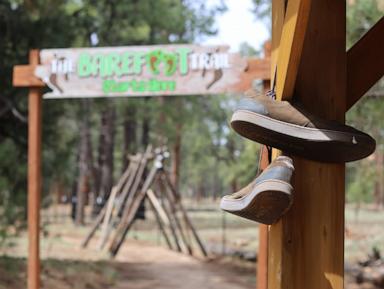
Earth Day marketing often pushes us toward expensive recycled gear and carbon-offset flights, but a growing global movement suggests that the most radical environmental act is simply taking off your shoes. Barefoot hiking—specifically on designated sensory trails across Europe and North America—is moving from a fringe "hippie" pastime into a serious health intervention. These trails aren't just paths; they are engineered environments designed to wake up the 200,000 nerve endings in the human foot that modern footwear has effectively silenced. While the average consumer spends hundreds of dollars on orthotics and cushioning, the biological reality is that we are weakening our foundations. This isn't just about "connecting with nature" in a poetic sense. It is about physical recalibration.
The Biomechanical Bankruptcy of the Modern Shoe
The human foot is an architectural masterpiece. It contains 26 bones, 33 joints, and over 100 muscles, tendons, and ligaments. For millennia, this structure adapted to varied terrain, providing a natural shock absorption system. Then came the industrial revolution and the subsequent rise of the athletic shoe industry. By encasing our feet in rigid soles and elevated heels, we have created a generation of people with "sensory amnesia."
When you walk on a groomed barefoot trail, you immediately notice the difference. You have to. On a standard hiking trail in boots, you stomp. You rely on rubber and foam to negate the ground. On a barefoot trail, such as the Barfußpfad in Bad Sobernheim, Germany, or the sensory loops in the Seoul woods, the ground becomes a data stream. Your brain receives constant updates on texture, temperature, and moisture. This feedback loop forces a shorter stride and a mid-foot strike, which significantly reduces the impact on your knees and hips.
We have spent decades over-protecting our feet to the point of atrophy. Proponents of these trails argue that by removing the barrier, we aren't just feeling the grass; we are retraining the brain to map the body correctly in space. This is proprioception. Without it, balance degrades, and the risk of injury in old age skyrockets.
A Tale of Two Continents and Two Philosophies
The barefoot trail phenomenon has evolved differently depending on which side of the Atlantic you stand. In Europe, particularly in Germany, Austria, and Switzerland, "Barfußparks" are integrated into the public health consciousness. These are often sophisticated circuits featuring pits of mud, cold mountain water, volcanic rock, and wood chips. They are treated less like a quirky afternoon activity and more like a spa treatment for the nervous system.
In North America, the approach is more rugged and individualistic. While official barefoot parks are rarer, the movement has manifested in the "rewilding" community. Here, the focus is on reclaiming public lands and national parks from the "leave no trace" ethos that sometimes accidentally creates a barrier between the human skin and the earth.
The European Model of Sensory Engineering
Take the Barfußweg in Celerina, Switzerland. It isn't just a walk in the woods. It is a sequence of tactile challenges. You move from the sharp, invigorating prickle of pine needles to the squelch of peat bog. The thermal contrast—walking from sun-warmed stones into a glacial stream—triggers a vascular workout. This is "Kneippism," a 19th-century hydrotherapy practice that remains a staple of European wellness. It suggests that these trails are not merely for leisure; they are a form of preventative medicine.
The American Re-wilding Movement
In the United States, barefooting often meets with bureaucratic resistance. Health codes and liability fears frequently mandate footwear in public spaces. However, in places like the Appalachian Trail or the coastal paths of the Pacific Northwest, a "barefoot elite" is proving that the human foot can toughen up to handle almost any terrain. The challenge here is not just the terrain, but the social stigma. Walking without shoes is often associated with poverty or a lack of hygiene, a cultural hurdle that European "barefoot parks" have successfully cleared by framing the activity as a conscious health choice.
The Hidden Science of Soil and Skin
There is a gritty, biological reality to these trails that goes beyond the "feel-good" Earth Day slogans. Soil is not just dirt; it is a complex microbiome. Research into Mycobacterium vaccae, a bacterium commonly found in soil, suggests that physical contact with the earth can actually boost serotonin levels and reduce anxiety.
When we walk barefoot, we are essentially "inoculating" ourselves with the local environment. While the skeptical observer might worry about parasites or bacteria, the veteran barefoot hiker knows that a healthy, calloused foot is a formidable barrier. The skin thickens, not into a hard, brittle crust, but into a leathery, flexible shield that maintains its sensitivity.
The benefits of regular barefoot trail usage include:
- Strengthened Arch Muscles: Correcting flat feet caused by over-supportive shoes.
- Reduced Inflammation: The theory of "earthing" suggests that direct contact with the earth's surface electrons can neutralize free radicals.
- Enhanced Balance: Re-engaging the small stabilizing muscles of the ankle and lower leg.
- Mental Clarity: It is impossible to ruminant on work stress when you are concentrating on the precise placement of your foot on a bed of river stones.
The Commercial Conflict of Interest
Why aren't doctors prescribing barefoot walks? The answer is partly economic. There is no money in a barefoot trail. You cannot sell a "barefoot" to a consumer who already owns two of them. The footwear industry is a multi-billion dollar machine that relies on the narrative that our feet are inherently broken and require technological intervention to function.
Even the "minimalist" shoe craze of the last decade was a double-edged sword. While it moved the needle toward more natural movement, it still kept the foot encased in synthetic materials. A true barefoot trail experience cannot be replicated by a five-fingered shoe or a thin-soled boot. The direct friction, the moisture of the moss, and the grit of the sand are essential components of the sensory experience.
Infrastructure and Access
The biggest barrier to this movement isn't a lack of interest; it is a lack of infrastructure. Building a high-quality barefoot trail requires more than just clearing a path. It requires:
- Material Sourcing: Finding non-toxic, rounded river stones, clean clay, and sustainable timber.
- Maintenance: Regular cleaning to ensure the path remains free of broken glass or hazardous debris.
- Education: Signage that explains the health benefits and encourages proper technique to prevent overexertion for beginners.
The Physical Toll of Transitioning
It is a mistake to think you can jump from a lifetime of cushioned sneakers to a five-mile barefoot hike without consequences. The muscles in your feet have likely been dormant for years. If you rush the process, you risk stress fractures, plantar fasciitis, and tendonitis.
The "barefoot veterans" I have interviewed all say the same thing: start small. Spend ten minutes on a patch of grass. Move to a gravel driveway. The pain you feel initially is not "damage"; it is a wake-up call. It is your nervous system screaming because it hasn't had to process this much data in years. Over time, that pain transforms into a sophisticated map of the world.
The Ecological Argument Beyond Symbolism
On Earth Day, we talk about "leaving no trace." Barefoot hiking is the ultimate expression of this. A rubber lug sole on a heavy hiking boot acts like a mini-bulldozer, displacing soil and crushing delicate micro-flora. A bare foot, by necessity, moves more lightly. You cannot stomp when your skin is the interface. You pick your way through the woods with a level of care and precision that a shod hiker simply cannot match.
This leads to a deeper psychological shift. When you are barefoot, you are no longer a tourist in the woods; you are part of the ecosystem. You feel the cold dampness of a shaded valley and the radiant heat of an exposed granite slab. This tactile intimacy builds a far more resilient conservationist mindset than any documentary or lecture ever could. You protect what you can feel.
The Path Forward for Urban Environments
We cannot all live near the Black Forest or the Swiss Alps. The future of the barefoot movement lies in "sensory pockets" within urban parks. Imagine a 200-meter loop of varied textures in the middle of Central Park or London’s Hyde Park. These would serve as "de-stressing stations" for office workers who spend their days disconnected from the physical world.
The cost to implement these is negligible compared to the construction of a tennis court or a playground. The primary obstacle remains the "yuck factor" and the litigious nature of modern society. We have become so afraid of the ground that we have cut ourselves off from a primary source of health and stability.
Tactical Steps for the Aspiring Barefooter
If you want to move beyond the Earth Day platitudes and actually change your physiology, don't buy new gear. Instead, find a patch of earth.
- Ditch the Socks: At home, go barefoot 100% of the time. Get used to the feel of different floor textures.
- Find a "Nursery" Path: Look for a well-maintained barefoot park if you are in Europe. If you are in the US or elsewhere, find a sandy beach or a clean, grassy park.
- Shorten Your Stride: Don't reach with your feet. Keep them under your center of gravity.
- Listen to the Feedback: If a surface hurts, don't power through it. It means your feet are still too weak or the surface is genuinely hazardous. Respect the signal.
The real revolution isn't digital; it's biological. Taking off your shoes is a quiet, defiant rejection of a lifestyle that prioritizes artificial comfort over functional strength. It is an admission that, despite all our technology, our bodies still belong to the earth.
Walk outside. Find a trail. Take off your boots. The world is waiting to be felt.