In a quiet laboratory tucked away in the 13th arrondissement of Paris, a researcher named Elodie watches a progress bar. It moves with the agonizing slowness of a glacier. This is not for lack of talent; Elodie is a graduate of the École Normale Supérieure, a mathematician whose mind functions like a finely tuned instrument. The problem is the silicon. Thousands of miles away, in a sprawling data center in Council Bluffs, Iowa, her counterparts are running the same experiment on clusters of H100 GPUs so vast they require their own power substations.
Elodie is fighting a war with a wooden shield.
Europe finds itself in a peculiar, haunting position. It is the world’s museum, its moral compass, and its most fastidious librarian. But as the era of generative artificial intelligence accelerates from a sprint to a warp-speed jump, the continent is waking up to a cold reality. It is possible to have all the right values and still become irrelevant.
The "gap" isn't just a matter of venture capital or lines of code. It is a fundamental rift in how the future is built. On one side, the United States operates on a philosophy of "permissionless innovation," fueled by a winner-take-all capital market. On the other, China utilizes a state-directed hyper-scale model where data privacy is a secondary concern to national utility. Europe sits in the middle, trying to build a digital superpower while handcuffed by its own commitment to being the world's most ethical regulator.
The Weight of the Golden Handcuffs
Consider the act of birth. When a startup is born in Silicon Valley, it is fed a diet of risk. Failure is a badge of honor, a necessary ritual. In Berlin or Brussels, failure is a stain. This cultural friction creates a tangible drag on the velocity of innovation.
Take the General Data Protection Regulation (GDPR). It was a landmark achievement in human rights, giving citizens back their digital identities. Yet, for an AI company trying to scrape the massive datasets required to train a Large Language Model, it is a labyrinth of mirrors. To train a model like GPT-4, you need the internet's collective memory. If that memory is fragmented by strict privacy borders, the resulting intelligence is inherently stunted.
European leaders often speak of "Digital Sovereignty." It sounds noble. It suggests a continent that controls its own destiny, free from the whims of California's tech titans or Beijing's censors. But sovereignty requires hardware. Currently, Europe produces less than 10% of the world’s semiconductors. When the supply chain for the most advanced chips bottlenecks, Europe is the last in line. You cannot legislate your way to a faster processor.
The Talent Drainage Basin
The most heartbreaking part of the gap isn't the lack of money. It’s the departures.
Think of a young engineer in Sofia or Lisbon. They are brilliant, hungry, and patriotic. But then comes the offer from a firm in San Francisco or Seattle. It isn't just the salary, though the 300% pay increase is hard to ignore. It is the density. It is the ability to walk into a coffee shop and sit next to the person who wrote the compiler for the language you’re using.
Europe suffers from a "brain drain" that has become a torrent. We educate the world’s best engineers and then watch them board flights to SFO. We provide the foundation—the public education, the healthcare, the social safety net—and the United States harvests the fruit. To close the gap, Europe doesn't just need more servers; it needs to give its people a reason to stay that is more compelling than "good work-life balance."
In 2023, the US saw roughly $67 billion in AI-related private investment. China followed with billions more in state-backed initiatives. The European Union? A mere fraction. The European Investment Fund is trying to bridge this, but it is fighting a fire with a squirt gun. European investors are notoriously risk-averse, preferring the steady returns of established manufacturing or luxury goods over the moonshot potential of a neural network that might be obsolete in six months.
A Different Kind of Intelligence
There is a counter-argument, whispered in the corridors of the European Parliament. It suggests that being first isn't the same as being right.
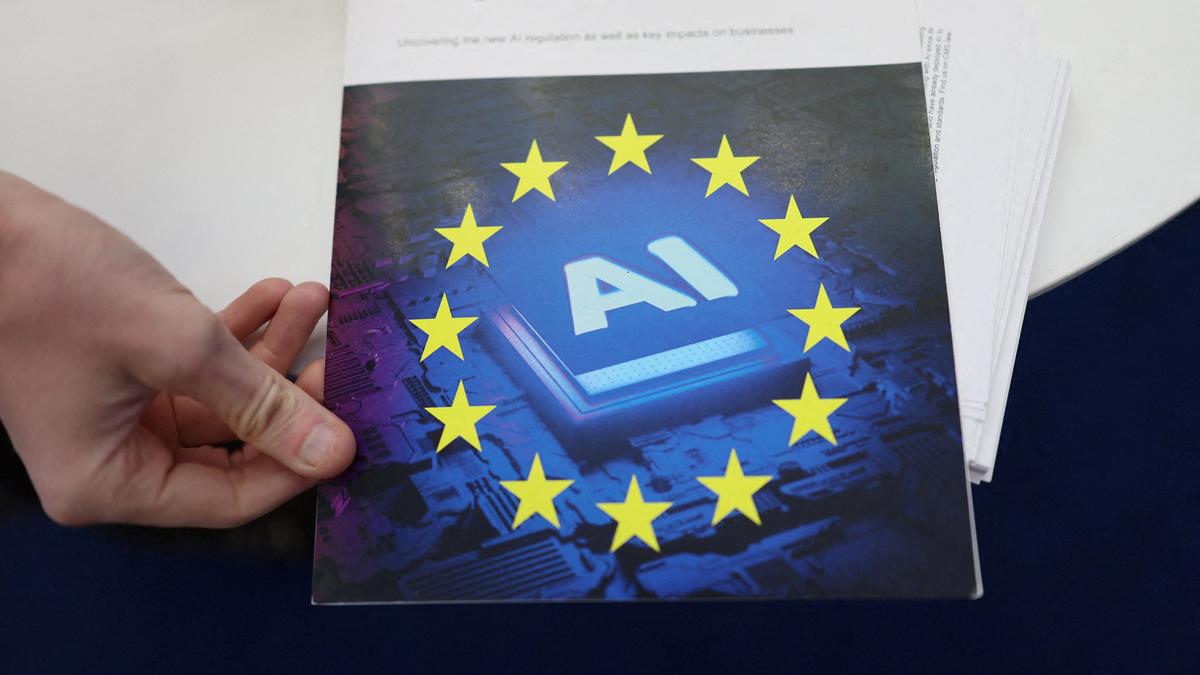
The "AI Act" is Europe’s big bet. It is the world’s first comprehensive framework for AI regulation, categorizing systems by risk. Critics say it will stifle innovation before it can breathe. Proponents argue it will create a "Brussels Effect," where European standards become the global default because companies would rather comply with one strict rule than fifty conflicting ones.
But there is a danger in being the world's referee when you don't have a team on the field.
Imagine a world where the primary tools for medical diagnosis, legal research, and creative writing are all owned by foreign entities. These tools are not neutral. They carry the biases, the cultural assumptions, and the political leanings of their creators. If a French doctor uses an AI trained primarily on American medical data, will it miss the nuances of local genetic markers or lifestyle factors? If a German judge uses a legal AI, does the "Common Law" logic of the training data begin to erode the Civil Law traditions of the continent?
This is the invisible stake. It is about the soul of the information we consume.
The Mistral Breeze
However, the story isn't entirely one of decline. There are flickers of a different path.
In France, a company called Mistral AI emerged almost overnight. Founded by former researchers from Meta and DeepMind, it raised hundreds of millions of euros with a lean, efficient approach. They aren't trying to build a bigger machine than OpenAI; they are trying to build a smarter one. They released "open-weight" models, allowing developers to see the guts of the system and build on top of it.
This is the European "Third Way."
It is an emphasis on efficiency over raw power. It is the realization that if you cannot outspend the giants, you must outthink them. By focusing on open-source contributions and B2B applications, Europe is carving out a niche that isn't about consumer chatbots, but about industrial integration. The factories of the Ruhr Valley and the shipyards of Scandinavia don't need an AI that can write poetry; they need an AI that can optimize a supply chain with 99.9% reliability.
The Infrastructure of Hope
To truly close the gap, the continent has to solve its "fragmentation" problem. Europe is not one market; it is a collection of twenty-seven different regulatory environments, languages, and tax codes. For a startup in Stockholm to expand to Madrid, it faces hurdles that a startup in New York moving to Los Angeles never dreams of.
The "Single Market" is a beautiful idea that remains, in the digital realm, a work in progress.
We also have to talk about the power. AI is hungry. It consumes electricity at a rate that threatens climate goals. Here, Europe has a potential advantage. With a more advanced green energy grid in many regions and a societal mandate for sustainability, Europe could become the home of "Clean AI." If the future of computing requires us to stop melting the planet, the continent's strict environmental standards might finally pay off.
But we are running out of time. The exponential curve of AI development doesn't wait for committee meetings or three-month vacation cycles.
Back in the Paris lab, Elodie finally sees the progress bar reach 100%. The results are promising, but she knows that by tomorrow, a lab in Palo Alto will have iterated on her findings ten times over using a cluster she can only dream of.
The gap is not a distance on a map. It is a measurement of belief. Europe must decide if it wants to be a museum where the world comes to remember the past, or a workshop where the world comes to build the future. It cannot be both while staying so cautious.
The ghost in the machine is waiting. It doesn't care about our history, our beautiful architecture, or our storied philosophers. It only cares about the next calculation. If Europe doesn't provide the spark, it will find itself sitting in the dark, perfectly regulated, and profoundly alone.
The silicon doesn't have a heart, but the people who program it do. The question isn't whether Europe can build a better processor, but whether it can build a world where the technology still serves the human, rather than the other way around. If they can solve that, the gap won't matter. But if they fail, they will be the most ethically compliant footnotes in someone else’s history book.