History is a ruthless editor. It doesn't just forget; it actively erases. If you were a woman in the sixteenth century who fell from grace—especially a woman who dared to sit on a throne—the men who followed you didn't just take your life. They took your face.
For centuries, we have looked at the portraits of Anne Boleyn and seen a specific, haunting archetype. The high cheekbones. The arched brows. The dark, enigmatic eyes that supposedly bewitched a king into breaking the world. Most of these images, including the famous one hanging in the National Portrait Gallery in London, were painted decades after her death. They are copies of copies, smoothed over by Elizabethan nostalgia or sharpened by Victorian drama. They are ghosts of a woman, but they are not the woman herself.
But there is a small, battered object that tells a different story. It is a lead disc, no larger than a modern coin, corroded by time and neglected by scholars for nearly five hundred years. It is known as the Moost Happi medal. And for a long time, it was our only certain link to how Anne actually looked.
The Face That Survived the Fire
When Henry VIII ordered Anne’s execution in 1536, he didn’t stop at the sword’s edge. He ordered her portraits burned, her emblems scraped from the walls of Hampton Court, and her very name excised from the record. To possess her likeness was to flirt with treason.
Yet, this one medal survived. Struck in 1534 to celebrate her pregnancy, it shows a woman with a strong, protruding chin, a slight swelling at the neck, and features that lack the conventional "pretty" delicacy of later paintings. For years, historians argued over whether this was a true likeness or a crude caricature. It was a singular, lonely data point in a sea of historical silence.
Then, technology caught up with the mystery.
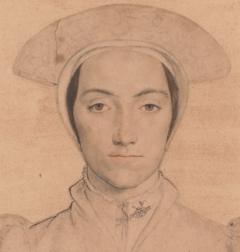
A few years ago, researchers began using facial recognition software—the kind usually reserved for catching criminals or unlocking smartphones—to cross-reference the Moost Happi medal with a mysterious sketch held in the Royal Collection at Windsor Castle. The sketch, a simple chalk drawing by Hans Holbein the Younger, is labeled "The Lady Marchioness of Dorset."
The software doesn’t care about politics or the romantic myths of the Tudors. It cares about the distance between the pupils, the bridge of the nose, and the structure of the jaw. When the algorithm mapped the medal onto the Holbein sketch, the results were staggering. The "Marchioness of Dorset" wasn't a Dorset at all. The bone structure matched the medal with a precision that defied coincidence.
The Human Behind the Icon
To understand why this matters, we have to look past the "B" pendant and the French hood. If the Holbein sketch is indeed Anne, we aren't looking at a seductress or a martyr. We are looking at a tired woman.
In the sketch, her hair is tucked away under a plain coif. Her expression is guarded, perhaps even a bit weary. This is a woman who had spent seven years in a brutal, public courtship, followed by three years of failing to produce a male heir for a man whose love was a lethal burden.
Consider the sensory reality of her world. The smell of woodsmoke and rushes. The constant, suffocating presence of spies behind every tapestry. The weight of the lead in that medal, which was likely cast in anticipation of a prince who would never be born. When we look at this "real" face, the tragedy shifts from a grand historical opera to a deeply personal horror story.
She wasn't a cardboard cutout of a villain or a saint. She was a person with a receding chin and a sharp mind who got caught in the gears of a dynastic machine.
The Nidd Hall Portrait and the Search for Symmetry
The detective work didn't stop at the medal. Another contender emerged from the shadows of a private collection: the Nidd Hall portrait. For a long time, it was dismissed as a generic Tudor lady. But when art historians and facial recognition experts applied the same rigorous mapping, the proportions of the face aligned perfectly with the Moost Happi medal.
This suggests that there was once a "master" portrait of Anne, a definitive likeness created during her brief window of power, from which these other works were derived. Imagine a court artist working feverishly to capture her image before the wind shifted. Imagine the courage it took for someone to hide that portrait in a cellar or behind a false wall when the King’s men came to burn it.
We are obsessed with these faces because we want to believe that we can see the soul through the eyes. We look at the "National Portrait Gallery Anne" and see the woman who changed the English Church. We look at the "Holbein Anne" and see the woman who was afraid of the dark.
The truth is likely somewhere in the middle, vibrating between the lead medal and the chalk lines.
Why the Mystery Refuses to Die
History is written by the survivors, but the truth is often buried with the victims. The reason we still argue over the bridge of a nose or the curve of a lip five centuries later isn't just about art history. It's about justice.
Every time a new scan or a new algorithm brings us closer to her actual features, we are reclaiming a piece of a woman who was systematically erased. We are refusing to let the executioner have the last word.
When you look at the Moost Happi medal today, you see the corrosion. You see the pitted surface of the lead. But if you tilt it just right in the light, the profile becomes clear. It is a face of defiance. It is a face that survived a King’s rage, a fire’s heat, and the slow, grinding indifference of time.
She is still here, watching us try to figure her out, a small, leaden ghost who refuses to stay forgotten.