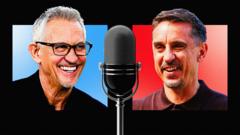
Gary Lineker and Gary Neville didn't just change the way we watch football. They changed who owns the conversation. For decades, the BBC and Sky Sports held all the cards. If you wanted to see the goals, you went to Lineker on a Saturday night. If you wanted the tactical breakdown, you tuned in for Neville’s iPad on a Monday. But while they were fronting the biggest shows in the country, they were secretly building empires that would eventually threaten the very broadcasters that made them famous.
This isn't just about two former players with nice suits and sharp opinions. It’s a full-scale corporate rivalry. Lineker’s Goalhanger Podcasts and Neville’s Buzz 16 are fighting for your ears, your eyes, and your subscription money. They've moved beyond being "talent." They’re now the gatekeepers.
Why the Old Broadcast Model is Dying
Broadcasters used to be the masters of the universe. They had the rights, the cameras, and the distribution. Lineker and Neville realized early on that the power was shifting to the individual brand. Social media and podcasting stripped away the need for a middleman. Why wait for a producer to greenlight your idea when you can just film it yourself and put it on YouTube?
Lineker’s move was calculated. Goalhanger isn't just a hobby. It's a production powerhouse that generates millions in revenue by owning the intellectual property of its shows. When you listen to The Rest is Football, you aren't just hearing three mates talk about the weekend’s games. You’re hearing a product owned by Lineker. He doesn't just get a fee; he gets the profit.
Neville took a different path but ended up in the same place. He built Buzz 16 to produce documentaries, live shows, and digital content like The Overlap. He understood that the modern fan wants intimacy. They want to see the legends sitting in a pub, not behind a sterile desk in a studio. By creating his own content, Neville made himself indispensable to Sky. They don't just hire him as a pundit; they often buy the shows he produces.
The Goalhanger Strategy versus the Buzz 16 Approach
Lineker’s Goalhanger has mastered the art of the "Rest Is" franchise. It started with The Rest is History, which proved that people have an enormous appetite for long-form, intelligent conversation. They applied that template to football with Lineker, Alan Shearer, and Micah Richards. It works because it feels effortless, even though it's backed by a sophisticated monetization engine.
They don't rely on one platform. They’re on Spotify, Apple, and YouTube. They have a massive social presence. Most importantly, they own the data. They know exactly who is listening and for how long. That’s data the BBC can’t leverage in the same way because of its public service remit.
Neville’s Buzz 16 is more about the spectacle and the "behind the scenes" access. The Overlap succeeded because it broke the fourth wall of sports broadcasting. It brought in Roy Keane and Jamie Carragher in settings that felt real. Neville’s genius was realizing that the rivalry between him and Carragher was a product in itself. He didn't just let it happen on Monday Night Football; he packaged it, sold tickets to live tours of it, and turned it into a digital juggernaut.
The Financial Stakes of Being a Media Mogul
We aren't talking about small change here. The revenue generated by these independent production houses is staggering. Goalhanger is reportedly bringing in six-figure sums every month just from advertising and sponsorships on its top-tier shows. They've expanded into politics and entertainment, diversifying their risk. If football fans get bored, they still have the history buffs and the political junkies.
Neville’s portfolio is even broader. He’s got his hotels, his property developments, and his university. Buzz 16 is the media arm of a much larger Gary Neville brand. He uses his media presence to drive interest in his other businesses. It’s a closed-loop economy. You watch him on The Overlap, you stay at his hotel in Manchester, and you follow his business advice on LinkedIn.
Moving Beyond the Punditry Box
The transition from player to pundit is common. The transition from pundit to mogul is rare. Most players are happy to take the paycheck and go home. Lineker and Neville are different because they aren't afraid of the "boss" label. They’ve become the people who hire and fire.
Lineker’s longevity at the BBC is often debated, usually regarding his tweets or his salary. But his real power lies in the fact that he doesn't actually need the BBC anymore. If he left tomorrow, Goalhanger would likely see a surge in listeners. He has successfully migrated his audience from a legacy platform to his own stable. That’s a terrifying prospect for traditional media executives.
Neville has done something similar with Sky. He’s made himself the face of the Premier League. Even when people disagree with his takes on ownership or the Super League, they’re still watching. He’s used his platform to influence the actual governance of the game, something a standard commentator could never do.
The Battle for Global Audiences
The UK market is finite. Both men have their sights set on the US and beyond. Lineker’s podcasts are already performing well globally, tapping into the massive English-speaking audience that craves high-quality football content. They’re competing with American giants like The Ringer and Barstool Sports.
Neville’s approach to global expansion is through collaborations. He brings in international stars and travels for his documentaries. He knows the "Class of 92" brand still has immense value in Asia and North America. He’s milking that nostalgia while simultaneously building something modern.
The Risks of Personal Branding
When the business is built on a person, the person becomes a liability. If Lineker says something controversial, it doesn't just affect his BBC contract; it could potentially hurt Goalhanger’s sponsors. We’ve seen this play out with his brief suspension from Match of the Day. The irony was that the suspension only made his personal brand stronger and drove more people to his private ventures.
Neville faces a similar tightrope. He frequently critiques the billionaire owners of football clubs while being a multi-millionaire businessman himself. He’s been called a hypocrite more times than he can count. But he doesn't care. He leans into the criticism. He knows that in the attention economy, being hated is almost as profitable as being loved. Just don't be boring.
What Traditional Broadcasters Get Wrong
The big mistake TV networks made was thinking they owned the talent. They thought they were providing the platform and the talent should be grateful. Lineker and Neville proved that the talent is the platform. Fans follow people, not logos.
The BBC and Sky are now in a position where they have to partner with these independent companies. They’re no longer just the employers; they’re the clients. Buzz 16 produces content for Sky. Goalhanger talent dominates the airwaves. The power dynamic has completely flipped.
The Future of the Lineker Neville Rivalry
Don't expect either of them to slow down. They’re competitive by nature. You don't play at the highest level of football for fifteen years without a desire to win. They’re now playing a different game, but the drive is the same.
Lineker will likely continue to expand the "The Rest is..." universe. There’s almost no limit to how many topics they can cover using that format. It’s a scalable, low-overhead business model that prints money. He’s building a legacy that will outlast his time on the television screen.
Neville will probably keep pushing into the intersection of sports, business, and politics. He’s already teased a move into more formal leadership roles within the game. Whether that’s owning more of a club or working with the regulator, his media empire gives him the leverage to make it happen.
How to Build Your Own Media Presence
If you’re looking at these two and wondering how to replicate even a fraction of their success, stop looking at their fame. Look at their ownership. They didn't just start podcasts; they started companies.
- Own your IP. Don't just be a freelancer for someone else’s brand. Create something that you own the rights to.
- Niche down then expand. Goalhanger started with history and football. They didn't try to cover everything at once.
- Be authentic to a fault. Neville is divisive because he’s honest about his biases. People trust that more than a "neutral" corporate voice.
- Diversify your platforms. If you're only on one social network, you’re a tenant. Build a mailing list or a podcast feed where you own the connection to your audience.
The era of the silent athlete is over. Lineker and Neville are the blueprints for the next generation. They’ve shown that the best way to predict the future of sports media is to own the company that creates it. Keep an eye on who is signing the checks, not just who is talking into the microphone. That’s where the real match is won.