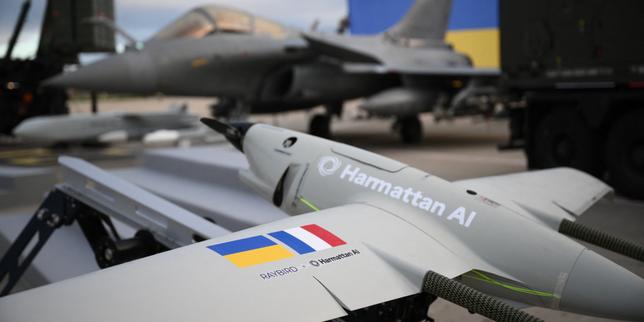
The French defense establishment is currently obsessed with a ghost. They look at the "boiling" drone market and see a gap in industrial sovereignty, a need for massive "Scaf" projects, and a desperate race to catch up with Turkey’s Bayraktar or the American Reaper. They are mourning a delay that doesn't matter because they are aiming at the wrong target. The consensus screams that France is late to the medium-altitude long-endurance (MALE) party. The truth? That party is over, and the house is currently being shelled.
We are witnessing the death of the "exquisite" platform. France’s military-industrial complex is biologically wired to build Ferraris—expensive, sleek, multi-role masterpieces like the Rafale. But the modern battlefield doesn't want a Ferrari. It wants five thousand Honda Civics with IEDs strapped to the hood. Meanwhile, you can find similar stories here: The Ghost in the Old World Machine.
If you think the problem is "uncertain industrial scaling," you’ve already lost the war. The problem is a refusal to accept that the era of the sovereign, high-cost drone is a relic of counter-insurgency operations in Mali. In a high-intensity conflict against a peer adversary, a €20 million drone is just a very expensive way to test the enemy’s €50,000 surface-to-air missile.
The Sovereignty Myth and the Eurodrone Trap
The "lazy consensus" argues that France must lead a European effort to ensure strategic autonomy. This has manifested in the Eurodrone—a massive, twin-turboprop beast that looks like it was designed by a committee trying to satisfy every civil aviation regulation in existence rather than a soldier trying to survive an electronic warfare environment. To understand the full picture, check out the detailed article by The Next Web.
The Eurodrone is a 10-ton dinosaur. It is too big to hide, too expensive to lose, and too slow to outrun anything. By the time it reaches full operational capability, its sensors will be looking at a battlefield where its own radar signature makes it a "shoot me" sign visible from three provinces away.
True sovereignty isn't owning the blueprints to a flying bus. True sovereignty is the ability to lose 500 units in a week and have 500 more roll off the assembly line on Monday. France’s current industrial structure is built for "artisanal" defense. We build 20 of something and call it a fleet. In the drone age, if you can’t treat your hardware as a consumable, you aren't a player; you’re a target.
Why High-End Electronics are a Liability
Industry insiders love to talk about "superior French optics" and "hardened data links." They miss the point of the attrition cycle.
In Ukraine, the average lifespan of a small drone is measured in hours. For a larger ISR (Intelligence, Surveillance, and Reconnaissance) platform, it's days. If you spend five years hardening a data link, the enemy will spend five weeks developing a new jammer that renders it moot.
The obsession with "multi-mission" capability is a poison. France wants its drones to do everything: SIGINT, strike, maritime surveillance, and tactical support. This leads to "feature creep," which leads to weight, which leads to cost, which leads to a fear of deployment. If a general is afraid to lose a drone because it costs a fraction of the national GDP, that drone is functionally useless.
I’ve seen programs stall for eighteen months because of a disagreement over sensor integration. Meanwhile, off-the-shelf components are being taped together in garages in Eastern Europe to kill T-90 tanks. The French "Direction Générale de l'Armement" (DGA) needs to stop trying to certify drones for flight over civilian Paris and start figuring out how to build them in a plywood factory.
The Logic of the Swarm Over the Logic of the Platform
The competitor's view is that France needs to bridge the gap in MALE and HALE (High-Altitude Long-Endurance) systems. They are wrong. France should skip that generation entirely.
Investing in MALE drones today is like investing in better cavalry in 1914. You are perfecting a tool that is fundamentally incompatible with the new lethality of the environment. The focus must shift to Distributed Lethality.
- Mass over Sophistication: A single sophisticated drone has one point of failure. A swarm of 100 simple drones has 100 points of failure. Which one is harder to stop?
- Software-First Architecture: We need to stop thinking about drones as "unmanned aircraft" and start thinking about them as "flying software." The airframe is irrelevant. It’s the autonomy, the computer vision, and the mesh networking that matter.
- The "Aarhus" Problem: Named after the Danish city, this thought experiment suggests that if you can't buy the components for your drone at a local electronics hobby shop, you can't win a prolonged war of attrition.
Imagine a scenario where a French division is engaged in a high-intensity conflict. They have three Eurodrones. Two are down for maintenance because a proprietary sensor from a sub-contractor is out of stock. The third is shot down by a Man-portable air-defense system (MANPADS) in the first hour. Now, they are blind.
Now imagine that same division has 2,000 "disposable" drones. They lose 400 to jamming. They lose 200 to bird strikes and bad weather. They still have 1,400 drones. They aren't just blind; they are everywhere.
The "Incuncertain" Scaling Is a Feature, Not a Bug
Critics moan about the "uncertainty" of the French drone sector. They point to the fragmented landscape of startups like Delair, Parrot, or Turgis & Gaillard. They want a "National Champion"—a single giant like Dassault to take over and bring order.
This is exactly what we don't want.
The fragmentation is the only thing keeping the sector alive. Small, agile companies can iterate in weeks. Large defense contractors iterate in decades. The "uncertainty" is actually a sign of a healthy, competitive ecosystem that hasn't yet been strangled by the bureaucracy of state-mandated consolidation.
The French government's role shouldn't be to pick a winner. It should be to provide a massive, simplified procurement fund that buys 10,000 units of whatever works today, even if it’s "imperfect."
The False Promise of Artificial Intelligence
Everyone is throwing the term "AI" around like a magic spell that will fix the drone gap. "We will use AI for target recognition," they say. "We will use AI for autonomous navigation."
This is a dangerous oversimplification. AI in a lab is easy. AI in a radio-silent, GPS-denied, smoke-filled environment is a nightmare. Relying on "AI-enabled" drones as a silver bullet for a lack of mass is a recipe for disaster.
France needs to focus on Electronic Warfare Resilience (EWR) rather than pure AI. If the drone can't find its way home when the GPS goes dark, all the "AI target recognition" in the world is just code sitting on a piece of falling debris.
Stopping the "Ferrari" Habit
The hardest part of this shift isn't the technology. It’s the culture.
The French Air and Space Force is built on the prestige of the pilot. The industry is built on the prestige of the high-performance jet. A drone that costs €5,000 and is designed to explode doesn't offer much prestige. It doesn't look good at the Paris Air Show. It doesn't provide 30 years of maintenance contracts for the big players.
But if France wants to be a military power in 2030, it has to stop building monuments to its own engineering ego.
We are currently seeing the "Aarok" drone being touted as a French powerhouse. It's a massive, impressive machine. It’s also exactly the kind of target that modern electronic warfare and long-range SAMs are designed to eat for breakfast. It’s a 2010 solution to a 2026 problem.
The Actionable Pivot
Stop trying to build a better Reaper. The Americans already did it, and even they are realizing the Reaper is too vulnerable for a fight with China.
Instead, France should:
- Divert 40% of the Eurodrone budget into "attrition-tolerant" systems.
- Mandate Open-Source Standards: No more proprietary data links that keep startups out of the loop. If your drone doesn't talk to the common French tactical network via an open API, it doesn't get funded.
- Legalize Risk: Allow for testing and deployment of systems that are "80% ready." The pursuit of the 100% solution is why we have no drones in the field today.
- Weaponize the Civilian Supply Chain: Build drones around the chips and motors used in the racing drone industry. They are cheaper, faster, and the supply chain is impossible to fully decapitate.
The "boiling" in the French drone sector isn't a sign of a rising power; it’s the sound of a system struggling to breathe under the weight of its own outdated requirements.
Stop designing drones for the DGA. Start designing them for the operator in a trench who needs a bird in the air in thirty seconds, doesn't care if it's "sovereign," and just needs it to hit the target before the jamming starts.
Everything else is just expensive nostalgia.
Build the swarm or prepare for the slaughter.