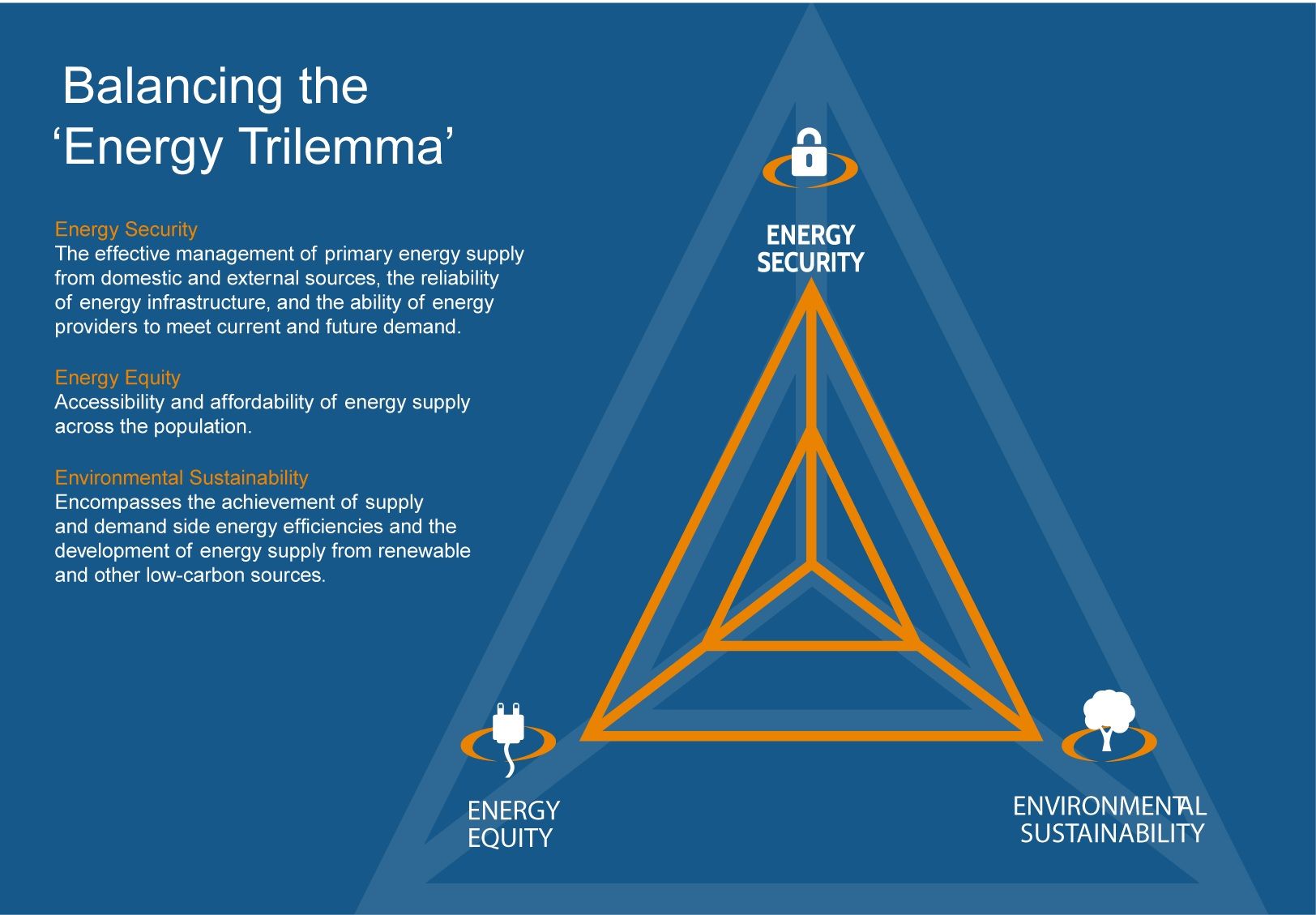
Energy security is no longer a peripheral concern of national defense; it is the primary constraint on industrial growth and digital sovereignty. The traditional approach to power infrastructure—treating it as a static utility—has collapsed under the pressure of intermittent generation and geopolitical volatility. To resolve this, modern energy strategy must move beyond the rhetoric of "transition" and focus on the mechanics of the Energy Trilemma: the simultaneous management of security, equity, and environmental sustainability.
The Tripartite Mechanics of Energy Security
Energy security is defined by the physical availability of supply at a price that does not trigger industrial contraction. This creates a cost function where the stability of a nation's GDP is directly tethered to the diversity of its energy inputs and the resilience of its transmission architecture.
The Security-Availability Coefficient
Security is a function of two distinct variables: Source Diversity and Infrastructural Redundancy.
- Source Diversity prevents single-point-of-failure scenarios where a disruption in one commodity (e.g., natural gas) halts the entire economy.
- Infrastructural Redundancy ensures that even if supply is available, the physical grid can handle surges or reroute power during localized failures.
The current failure in many Western economies is the prioritization of decarbonization without first establishing the necessary baseload redundancy. When intermittent sources like wind and solar replace synchronous generation (coal, gas, nuclear) without massive increases in storage capacity, the system loses its inertia. Grid inertia is the kinetic energy stored in large rotating generators that helps the system maintain a steady frequency. Losing this makes the grid hypersensitive to minor disturbances, increasing the risk of cascading blackouts.
The Decoupling of Supply and Demand Dynamics
The fundamental challenge of modern energy policy is the widening gap between the physics of the grid and the economics of the market.
Intermittency and the Storage Deficit
Renewable energy introduces a "Value Deflation" problem. Because solar and wind often produce the most power when demand is low, the market price of electricity can drop to zero or even turn negative during peak production hours. This disincentivizes the very investment needed to build more capacity.
The mechanism required to fix this is not just "more batteries," but a tiered storage strategy:
- Short-Duration Storage (Minutes to Hours): Lithium-ion and flywheels to manage frequency and daily peaks.
- Long-Duration Storage (Days to Weeks): Flow batteries or thermal storage to handle multi-day weather events where renewable output drops.
- Seasonal Storage (Months): Hydrogen or synthetic fuels that capture summer surplus for winter deficits.
Without this tiered structure, increasing renewable penetration beyond a certain threshold—often cited as 30-40% depending on the specific grid—leads to diminishing returns and increased system-wide instability.
The Geopolitical Risk of the Supply Chain
Transitioning from a fuel-intensive system (oil and gas) to a material-intensive system (minerals for batteries and turbines) does not eliminate energy dependency; it shifts the geography of that dependency. The concentration of rare earth elements and processing capacity in a handful of jurisdictions creates a "Resource Choke Point." A strategic energy policy must account for the "Embedded Energy" in the supply chain—the fuel used to mine, refine, and transport the materials needed for green infrastructure.
Rationalizing the Nuclear Baseload
No high-output industrial economy has successfully decarbonized without a significant contribution from nuclear power or large-scale hydroelectricity. The logic is simple: high energy density.
A single uranium fuel pellet provides as much energy as 17,000 cubic feet of natural gas or 120 gallons of oil. This density translates to a smaller physical footprint and a more manageable supply chain. The primary bottleneck for nuclear is not technology, but the "Regulatory Risk Premium." High capital costs are driven by decade-long construction timelines and shifting safety standards that prevent standardized, modular building practices.
The shift toward Small Modular Reactors (SMRs) represents a move from custom-built civil engineering projects to factory-manufactured products. This reduces the "Cost of Capital" by shortening the time to revenue and allowing for incremental capacity additions rather than multi-billion-dollar bets on single, large-scale plants.
The Grid as a Computational Challenge
The modern grid is transitioning from a unidirectional flow (Power Plant -> Consumer) to an omnidirectional network. This requires a level of computational overhead that existing legacy systems cannot support.
Demand-Side Response and Edge Intelligence
Instead of only scaling supply to meet demand, the system must scale demand to meet supply. This involves "Load Shedding" and "Peak Shifting" through automated industrial responses. For instance, data centers or aluminum smelters—both massive energy consumers—can be incentivized to reduce their draw during peak grid stress in exchange for lower base rates.
This creates a "Virtual Power Plant" (VPP) where the aggregate reduction in demand is functionally equivalent to an increase in supply. Implementing this requires:
- High-Frequency Telemetry: Real-time data on consumption at the household and industrial level.
- Automated Arbitrage: Software that automatically shifts non-critical loads (like EV charging or water heating) to periods of high supply.
The Economic Reality of the Energy Premium
Energy is the "Master Resource." When the price of energy rises, the price of every other good and service follows because energy is an input for all production and logistics. Governments that ignore the "Energy Premium"—the extra cost paid for inefficient or insecure energy—risk permanent industrial flight to regions with lower costs.
The "Levelized Cost of Energy" (LCOE) is a flawed metric because it often ignores "System Costs." LCOE measures the cost of a single plant in a vacuum. System costs include the backup plants, the extra transmission lines, and the storage needed to make that plant's output useful to the grid. When system costs are factored in, the perceived cheapness of some renewable sources evaporates.
Strategic Realignment: A Modular Implementation Path
To secure energy sovereignty while maintaining economic competitiveness, a three-phase operational plan is necessary.
Phase 1: Hardening the Legacy Core
Immediate investment must be directed toward the life-extension of existing nuclear and high-efficiency gas plants. These provide the "Bridge Capacity" required to prevent supply shocks while newer technologies scale. This phase also requires the streamlining of permitting processes for high-voltage transmission lines, which currently take longer to approve than the power plants they connect.
Phase 2: Decoupling the Supply Chain
Nations must prioritize "Friend-shoring" and domestic processing of critical minerals. Strategic reserves should not be limited to oil; they must include a 90-day supply of processed materials required for the maintenance of the renewable and electrical grid.
Phase 3: Total System Integration
The final step is the deployment of a "Heterogeneous Grid" that combines baseload nuclear with high-penetration renewables and massive, tiered storage. This system is managed by AI-driven dispatch algorithms that predict weather patterns and consumer behavior to balance the grid in real-time.
The path forward requires abandoning the binary choice between "Green" and "Secure." A grid that is green but unstable is a liability; a grid that is secure but carbon-intensive is a long-term economic risk. The only viable strategy is an "All-of-the-Above" approach that prioritizes energy density and system inertia over ideological purity.
The immediate strategic play for any industrial nation is the aggressive acceleration of nuclear modularization and the simultaneous mandate for long-duration storage integration for every new megawatt of intermittent capacity added to the grid. Failure to synchronize generation with storage is an implicit vote for future energy rationing.