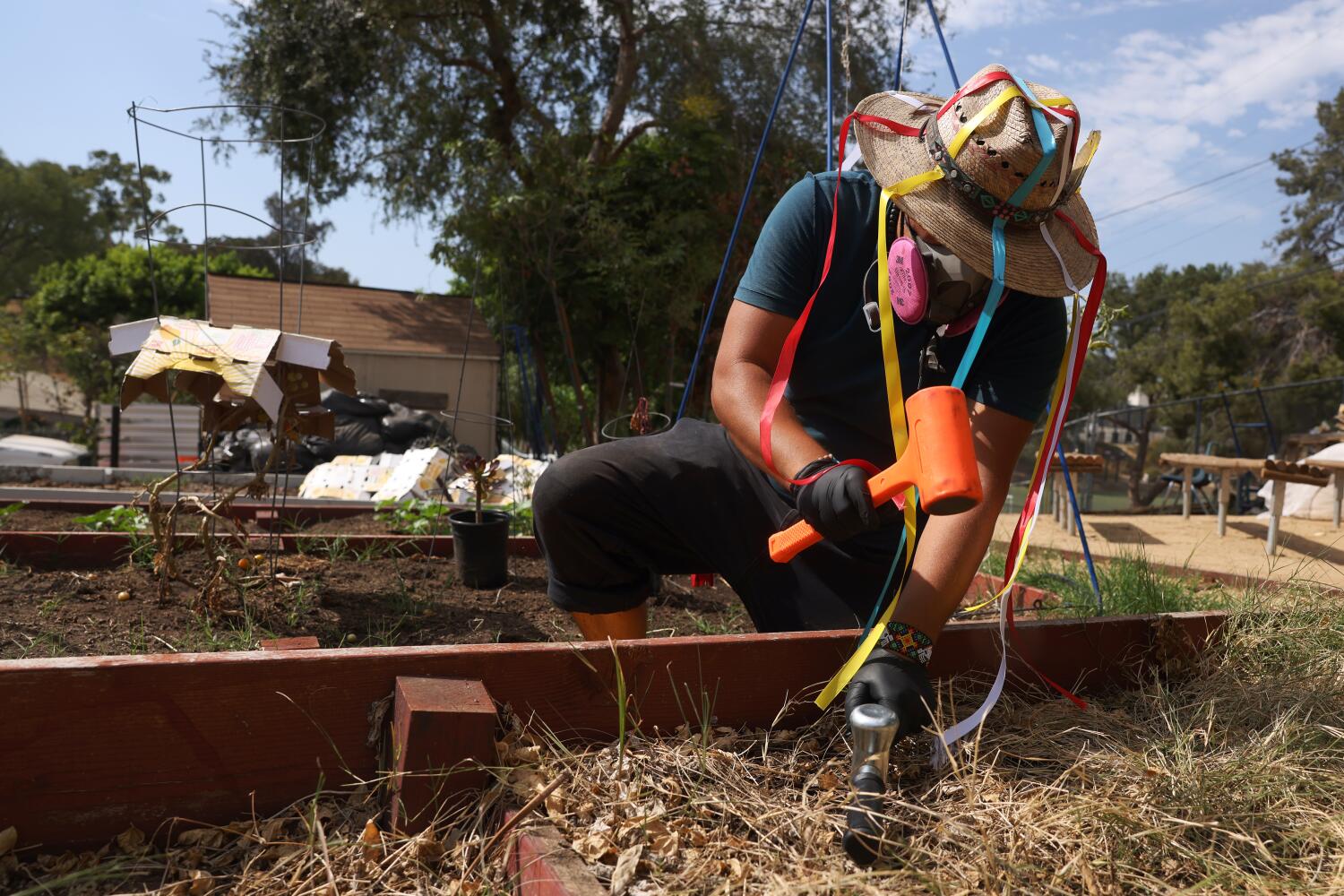
The dirt under a child’s fingernails usually tells a story of a day well spent—climbing trees, digging for imaginary treasure, or wrestling in the grass. But in the shadows of the old Exide battery recycling plant in Vernon, California, that dirt tells a darker story. It is a story written in microscopic flakes of lead, a heavy metal legacy that refuses to be washed away.
Monserrat’s garden should be a sanctuary. Instead, it is a crime scene. She stands in the center of her small yard, pointing at a patch of bare earth where the grass gave up years ago. For decades, the Exide plant exhaled a toxic breath, scattering lead dust across thousands of homes in Southeast Los Angeles. The plant is gone now, shuttered in 2015, but its ghost remains in the topsoil.
It is invisible. It is odorless. And for the families living in the "cleanup zone," it is a slow-motion catastrophe.
The Weight of a Grain of Salt
Lead is a patient poison. It doesn’t scream; it whispers. When a child breathes in the dust or accidentally swallows a smudge of contaminated soil, the lead enters the bloodstream and mimics calcium. It tricks the body. It slips into the bones. It crosses the blood-brain barrier.
The medical community often speaks in parts per million, a metric that feels abstract until you realize that a tiny, barely visible speck of lead can permanently alter a child's cognitive trajectory. We are talking about the loss of IQ points, the onset of behavioral disorders, and a lifetime of neurological hurdles.
State officials promised a solution. They promised a massive cleanup, the largest of its kind in California's history. They arrived with backhoes and plastic sheeting, hauling away tons of earth. But as the years grind on, the reality on the ground has shifted from hope to a grinding, weary skepticism.
The problem isn't just that the dirt is being moved. The problem is that the dirt keeps coming back.
A Patchwork of Safety
Imagine a checkerboard. One square is scrubbed clean, the top six inches of soil replaced with fresh, tested dirt. The square next to it, however, remains untouched because the homeowner couldn't be reached or the funding ran dry. When the wind kicks up on a dry Tuesday afternoon, the dust doesn't respect those property lines. It migrates. It drifts from the contaminated lot to the "clean" one.
This is the re-contamination loop.
Contractors hired by the Department of Toxic Substances Control (DTSC) have cleared thousands of properties, yet many residents report that their "clean" yards still test high for lead just months later. It is a Sisyphean task. For every truckload of poison removed, the surrounding environment—the parkways, the rooftops, the unpaved alleys—remains a reservoir for the toxin.
The state’s strategy has been criticized for its surgical precision in a situation that requires a sledgehammer. By focusing only on specific residential yards while leaving the broader infrastructure of the neighborhood untreated, they have created a series of clean islands in a sea of lead.
The Cost of Being Overlooked
There is a specific kind of exhaustion that settles into the bones of people who have been told to wait. Monserrat and her neighbors aren't just fighting a chemical; they are fighting a bureaucracy that seems to view their health as a line item on a budget that is always under threat.
In wealthier zip codes, an environmental disaster of this scale would likely have been met with a scorched-earth response. In Vernon and the surrounding working-class, predominantly Latino communities, the response has been a series of starts and stops. There is a feeling of being a second-class citizen in one's own backyard.
Why are the parkways left out? Why are the interiors of the homes—where the dust has settled into the carpets and the cracks of the floorboards for fifty years—not part of the standard remediation?
The questions hang in the air, much like the dust itself.
Logistics often get in the way of justice. To truly clean a home, you have to look at the roof. Lead dust settles in the shingles. When it rains, the water carries that lead down the gutters and right back into the "clean" soil. Without a comprehensive approach that includes cleaning roofs, interiors, and public spaces, the residential soil cleanup is a temporary bandage on a deep, infected wound.
The Chemistry of Silence
Science tells us there is no safe level of lead exposure for a child. None.
Yet, the state uses a "cleanup goal" of 80 parts per million. While this is stricter than the federal standard, it acknowledges a grim reality: they aren't aiming for zero. They are aiming for "good enough."
For a parent, "good enough" is a terrifying phrase. It means your child is still an experiment. It means when they play outside, you are still watching the clock, still wondering if the dust on their shoes is just dirt or a thief of their future potential.
The psychological toll is a heavy, leaden weight of its own. Parents describe a constant state of hyper-vigilance. You become an expert in things you never wanted to know. You learn about soil acidity, the half-life of heavy metals, and the specific way lead binds to blood cells. You learn to mop with a damp cloth instead of sweeping, because sweeping just sends the poison airborne.
You learn to live in a home that feels like a trap.
The Ghost in the Machine
The Exide plant was a recycler. It was supposed to be part of the "green" economy, turning old car batteries into new ones. It is a bitter irony. In the pursuit of recycling, they ended up contaminating the very earth they occupied.
The company eventually filed for bankruptcy, walking away from the mess and leaving California taxpayers to foot the multi-billion-dollar bill. It is a familiar script in the American industrial narrative: privatize the profits, socialize the toxins.
But the money isn't the point. The point is the time.
Every year the cleanup drags on is another year of exposure for a new crop of toddlers. Lead doesn't wait for budget cycles. It doesn't care about administrative delays or contractor disputes. It simply does what it does. It accumulates.
A Different Kind of Mapping
If you look at a map of the cleanup zone, you see a cluster of pins representing thousands of homes. It looks like a military operation. But if you zoom in, you see the individual lives. You see the grandmother who stopped growing tomatoes because she’s afraid to eat anything that comes out of the ground. You see the father who spends his weekends power-washing his driveway, a futile ritual against an invisible enemy.
The true map of the Exide disaster isn't drawn in property lines. It is drawn in the medical records of local elementary schools. It is drawn in the tired eyes of community activists who have been shouting into the wind for a decade.
There is a gap between the "completed" status of a property and the feeling of safety for the family living there. That gap is where the trust has dissolved. To rebuild it, the state must move beyond the yard. They must acknowledge that a neighborhood is an ecosystem, not a collection of isolated dirt lots.
They must clean the streets. They must clean the rafters. They must clean the very air that these families breathe.
The Lingering Breath
The sun begins to set over Vernon, casting long shadows from the industrial skeletons that still dot the horizon. The air feels still.
In Monserrat’s yard, a small plastic truck lies forgotten near the fence. It is covered in a fine layer of greyish powder. To an outsider, it’s just dust. To anyone who lives here, it is a reminder that the past is never truly buried. It stays on the surface, waiting for a breeze, waiting for a curious hand, waiting for the next generation to breathe it in.
The plant is silent now. The smokestacks are cold. But in the quiet of the evening, you can almost hear the lead moving, shifting through the soil, a silent traveler in a land that was promised a clean start but was given a compromise instead.