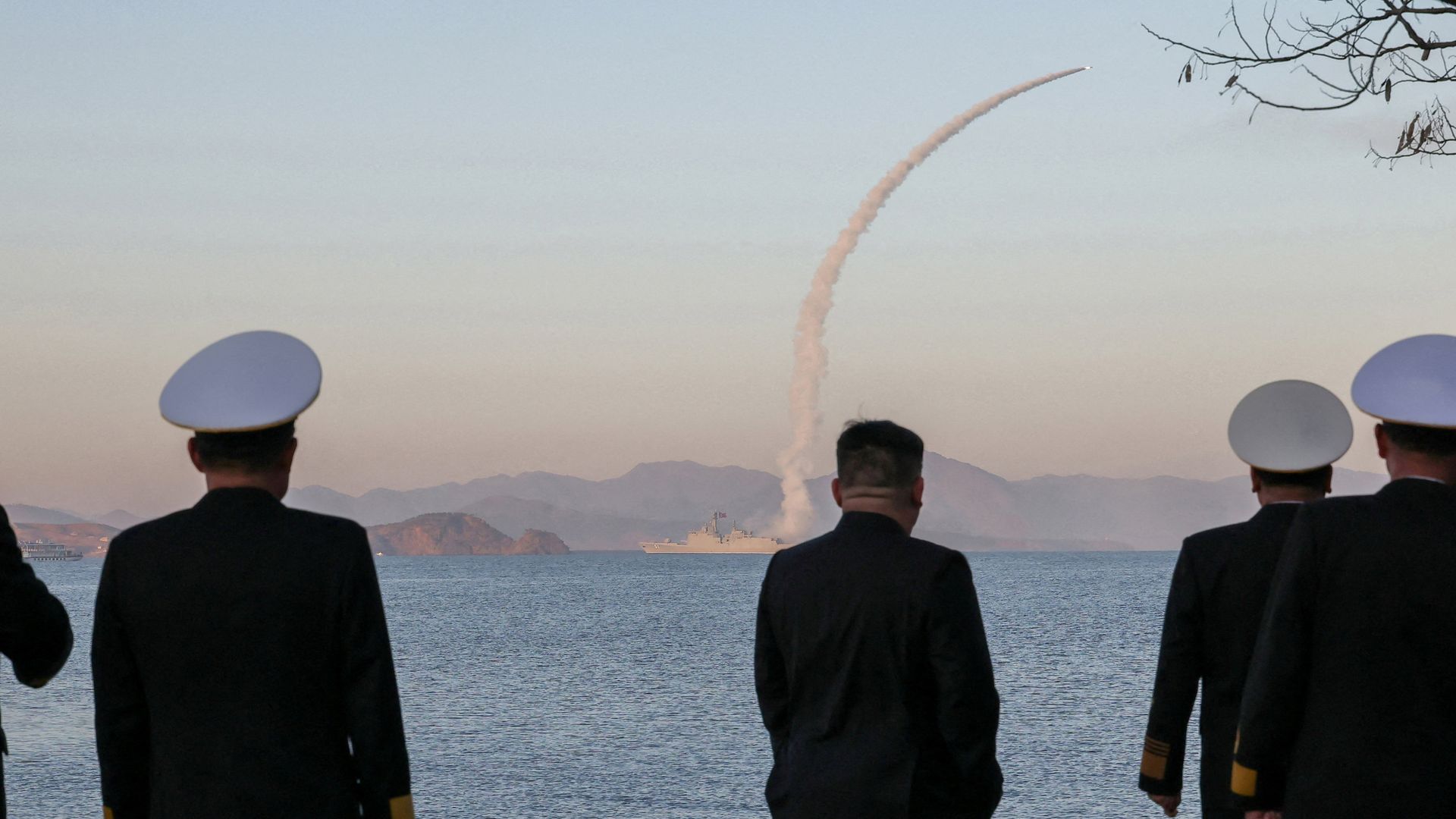
Pyongyang has officially moved its nuclear ambitions from the mud of inland launch pads to the unpredictable swells of the West Sea. On Sunday, Kim Jong Un stood on a pier to witness the Choe Hyon, a 5,000-ton destroyer and the crown jewel of his modernized surface fleet, fire a volley of strategic cruise missiles and anti-ship projectiles. This was not a mere technical check. It was a formal declaration that the North Korean Navy is no longer just a "brown water" force of aging coastal patrol boats, but a platform for sea-based nuclear strikes.
The test involved two strategic cruise missiles—likely variants of the Hwasal-2—which stayed airborne for over two hours, and three anti-ship missiles that burned for 30 minutes before striking targets with what state media called "ultra-precision." By placing these long-range, nuclear-capable weapons on a 5,000-ton hull, Kim is attempting to solve a perennial problem: how to make a fixed, easily targeted nuclear arsenal mobile and survivable.
The Choe Hyon Architecture
For decades, the North Korean Navy was the neglected stepchild of the military, forced to make do with 1950s-era Soviet designs. The Choe Hyon represents a radical departure. Analysts observing the vessel note its modern lines, which mimic the stealthy profiles of contemporary Western or Chinese frigates.
The ship reportedly features an integrated weapons command system and upgraded anti-jamming navigation. More importantly, it marks the first time Pyongyang has successfully integrated Vertical Launch System (VLS) technology or advanced rail-launchers onto a vessel of this displacement. The 5,000-ton class gives the vessel enough stability to operate in heavier seas, extending the reach of North Korea’s "second strike" capability far beyond its immediate coastline.
However, the hardware tells only half the story. The Choe Hyon did not emerge from a vacuum. South Korean intelligence and independent defense analysts point toward a deepening, shadowy cooperation with Moscow. Since 2024, the exchange of Russian missile technology for North Korean artillery shells has accelerated. The sleek design of the Choe Hyon and its sophisticated guidance systems bear the hallmarks of Russian engineering influence, suggesting that Kim is bypassing years of trial-and-error by importing foreign blueprints.
The Logic of Strategic Cruise Missiles
Why cruise missiles? Unlike ballistic missiles, which fly in a predictable arc and are easily tracked by regional radar, cruise missiles like the Hwasal-2 hug the terrain or the waves. They fly at low altitudes, often below 100 meters, making them nearly invisible to traditional missile defense systems like THAAD or Aegis until it is too late.
- Range: The two-hour flight time suggests a range of approximately 1,500 to 2,000 kilometers. This puts every major U.S. base in Japan, as well as Guam, within a precision strike envelope.
- Warhead Versatility: These missiles are designed to carry the Hwasan-31 tactical nuclear warhead. This miniaturized device is the linchpin of North Korea’s strategy to "normalize" nuclear use on the battlefield.
- Saturation Tactics: By launching from a destroyer, North Korea can coordinate these strikes with land-based batteries, overwhelming an enemy’s defensive processing power.
The Sunday test was specifically designed to verify "anti-jamming performance." This is a direct response to the sophisticated electronic warfare suites employed by the U.S. Navy. If Pyongyang can prove its missiles can navigate through a jammed environment, the deterrent value of the Choe Hyon increases exponentially.
A Fleet Built on Friction
The rapid development of this destroyer class has not been without its failures. Investigative lookbacks reveal that a sister ship, the Kang Kon, reportedly suffered a catastrophic propulsion or launch failure in Chongjin last year, leading to a temporary disappearance of the vessel from satellite imagery. Kim’s presence at the Choe Hyon test serves as a "reset," signaling to his domestic audience and the world that the technical hurdles have been cleared.
But a large warship is a massive, floating target. While the Choe Hyon looks impressive, it lacks the sophisticated multi-layered air defense bubble that protects an American or Japanese destroyer. Without a fleet of supporting ships or a carrier air wing, the Choe Hyon is essentially a "glass cannon"—capable of a devastating first blow but unlikely to survive a sustained engagement.
Pyongyang seems to understand this. They aren't building a navy to win a conventional war; they are building a navy to ensure that the cost of starting one is a nuclear exchange.
The Russian Connection and the Third Destroyer
Kim Jong Un is already looking past the Choe Hyon. Reports from the state-run KCNA indicate that he reviewed plans for a third and fourth destroyer currently under construction. This pace of production is staggering for a nation under heavy international sanctions.
The "limitless expansion" Kim called for on the pier suggests a shift in the regional balance of power. If North Korea can field a half-dozen of these 5,000-ton vessels, they can maintain a constant presence in the Sea of Japan and the Yellow Sea. This forces the U.S. and its allies to dedicate constant surveillance assets to track every hull, stretching resources thin during a period of global instability.
The reality of the Choe Hyon is that it is a psychological weapon as much as a kinetic one. It represents the physical manifestation of Kim’s refusal to be contained. By moving his "strategic" weapons to the sea, he has complicated the calculus for every general in the Indo-Pacific. The question is no longer where the missiles are hidden in the mountains, but which wave they might appear from next.
The commissioning of this vessel, scheduled for this week, marks the end of the prototype phase. The era of the North Korean blue-water nuclear threat has begun.