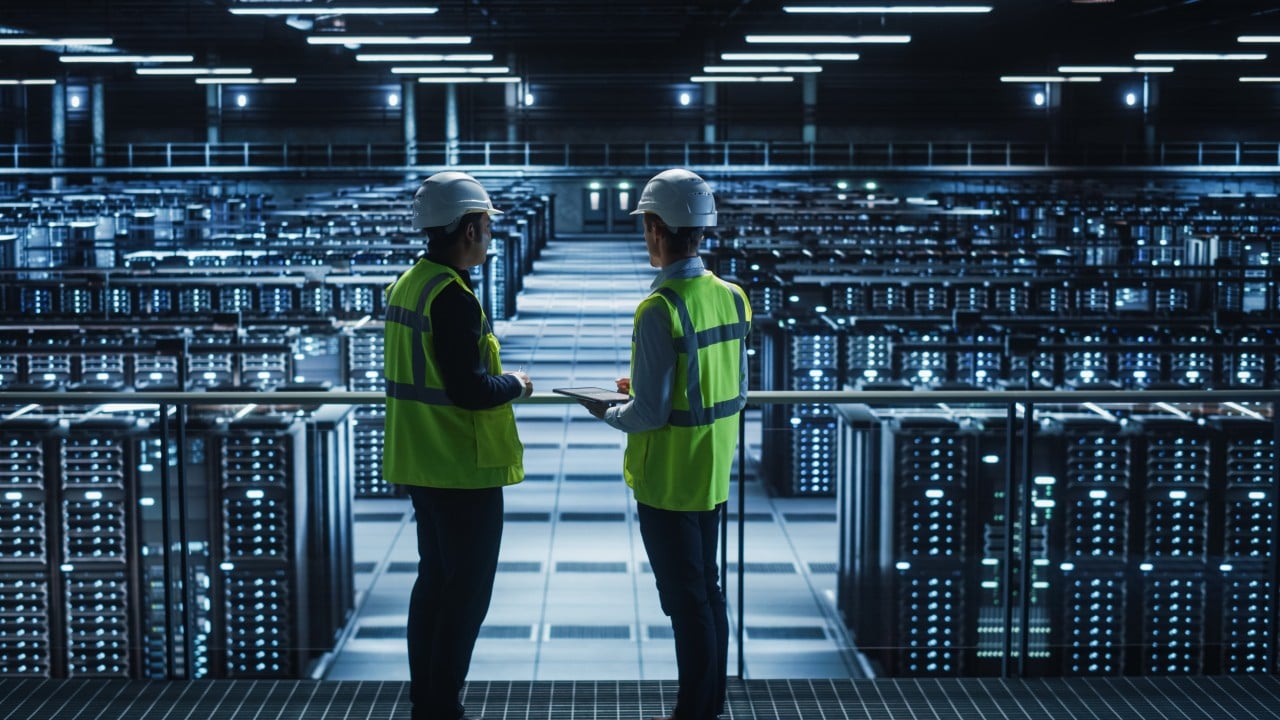
China is currently overhauling its industrial and digital infrastructure to prevent a massive spike in carbon emissions from derailing its 2030 climate targets. The central government recently issued a sweeping directive aimed at the "green transition" of its economy, with a specific focus on two massive energy consumers: heavy industry and the rapidly expanding fleet of artificial intelligence data centers. This move attempts to balance the desperate need for computing power with the rigid requirements of carbon peaking. It is a high-stakes gamble on efficiency technology that the rest of the world is watching closely.
The problem is straightforward but immense. Beijing has pledged to reach peak carbon emissions by 2030 and achieve carbon neutrality by 2060. However, the global AI arms race has forced a massive build-out of high-performance computing clusters. These facilities are not your father’s server rooms. They are energy-intensive monsters that require constant cooling and a reliable, high-voltage power supply. At the same time, traditional sectors like steel, cement, and petrochemicals remain the backbone of the Chinese economy, and they are notoriously difficult to decarbonize.
The Physical Cost of Virtual Intelligence
For years, the tech industry operated under the illusion that digital growth was inherently cleaner than physical manufacturing. That myth has shattered. A single large language model requires thousands of specialized chips running at full throttle for months just to train. Once deployed, every query consumes a measurable amount of electricity. China’s push into AI is now clashing directly with its environmental ledger.
The new policy frameworks demand that data centers improve their Power Usage Effectiveness (PUE). This is a ratio of how much energy goes into the actual computing versus how much is wasted on cooling and overhead. In many older Chinese facilities, the PUE remains stubbornly high. The government is now mandating that new national-level hubs achieve a PUE of 1.25 or lower. For context, a PUE of 1.0 would be a perfect, lossless system. Achieving 1.25 in the humid, southern provinces of China is a brutal engineering challenge that requires more than just better fans. It requires a complete rethink of how heat is moved.
Liquid Cooling and the Death of Air
Air is a terrible conductor of heat. As chip densities increase, traditional air conditioning units simply cannot keep up with the thermal output of high-end GPUs. This has led to a surge in liquid cooling adoption. In these setups, coolant is piped directly to a cold plate sitting on top of the processor, or the entire server is submerged in a non-conductive fluid.
While this technology is efficient, it is also expensive and complex to maintain. It introduces a new set of risks. A leak in a liquid-cooled rack can be catastrophic. Despite these risks, the state is pushing hard for this transition because there is no other way to pack the necessary computing power into a sustainable energy footprint. This isn't about being "green" for the sake of the planet alone; it's about energy security and avoiding the localized blackouts that have plagued industrial hubs in recent years.
Heavy Industry and the Carbon Budget
While data centers are the new, flashy problem, the old problems are still burning coal. China produces over half of the world’s steel and cement. These industries are the primary reason the country is the world's largest emitter of greenhouse gases. The strategy here is not just to make these plants "better" but to integrate them into a circular energy economy.
One of the more ambitious parts of the new directive involves the electrification of industrial heat. Many manufacturing processes rely on burning coal or gas to create high temperatures. Transitioning these to electric furnaces powered by renewable energy is the goal. But the grid isn't ready. You cannot simply plug a massive steel mill into a local wind farm and expect it to work 24/7. The intermittency of renewables remains the ghost in the machine.
The Hydrogen Hedge
China is betting heavily on green hydrogen to bridge the gap in heavy industry. By using excess wind and solar power to split water molecules, they can create a fuel that burns clean. This hydrogen can then be used in "hard-to-abate" sectors like heavy trucking and steel production.
The infrastructure for this is currently being built at a staggering pace. However, the economics are still shaky. Green hydrogen is currently much more expensive than the "grey" hydrogen produced from natural gas. The government is using subsidies and state-owned enterprise mandates to force the market into existence, hoping that scale will eventually bring the costs down. It is a top-down approach that ignores short-term market pain in favor of long-term structural dominance.
The Grid as a Bottleneck
All of these plans—the more efficient data centers, the electric steel mills, the hydrogen electrolyzers—rely on a power grid that can handle the load. China’s grid is one of the most sophisticated in the world, but it is still heavily reliant on the north-to-south and west-to-east transfer of power. Most of the renewable energy is generated in the sparsely populated west, while the demand is in the industrial east.
Ultra-High Voltage (UHV) transmission lines are the solution Beijing has chosen. These are the massive "electricity highways" that move power across thousands of miles with minimal loss. But even these lines have limits. The grid needs more than just wires; it needs massive energy storage. This is why we see a sudden explosion in pumped-hydro storage projects and large-scale battery installations. Without these, the "green" transition is just a series of disconnected projects that risk collapsing during a peak-load event.
The Digital Twin of the Energy System
To manage this complexity, China is using the very AI that is causing the power drain to manage the grid. They are creating "digital twins" of entire provincial power networks. These models use real-time data to predict demand surges and adjust the flow of electricity accordingly.
There is a certain irony in using energy-hungry AI to save energy on the grid. If the AI can optimize the dispatch of renewable energy and reduce the reliance on coal-fired "peaker" plants, it might pay for its own carbon footprint. But that is an "if" that rests on the quality of the data and the stability of the software.
The Geopolitical Pressure Cooker
Internal climate goals are only half the story. The Carbon Border Adjustment Mechanism (CBAM) from the European Union is a looming threat to Chinese exports. If Chinese steel or electronics carry a high carbon footprint, they will be hit with massive tariffs when entering the European market. This makes decarbonization a matter of survival for China's export-led economy.
The United States has also introduced various trade barriers and incentives for green tech, such as the Inflation Reduction Act. This has turned the green transition into a competitive race. China wants to own the supply chain for the future: the batteries, the solar panels, the electrolyzers, and the high-efficiency chips. By forcing its domestic industries to modernize now, it is positioning itself to be the global provider of low-carbon industrial solutions in the 2030s.
The Unspoken Tradeoffs
This aggressive push comes with significant friction. Small and medium-sized enterprises (SMEs) often lack the capital to invest in the expensive equipment required to meet new environmental standards. There is a real risk that the drive for a "greener" economy will result in further market consolidation, where only the massive, state-backed firms can afford to play.
Furthermore, the environmental impact of building all this "green" infrastructure is rarely discussed. The mining of lithium, cobalt, and rare earth minerals for batteries and motors has its own ecological and social cost. China controls much of this mining, but the localized pollution in mining districts is the dark side of the national carbon-neutrality goal.
The Efficiency Paradox
A recurring theme in industrial history is Jevons’ Paradox: as a resource becomes more efficient to use, we often end up using more of it, not less. If China makes its data centers 20% more efficient, it may simply encourage the construction of 40% more data centers. The demand for compute is seemingly bottomless.
This is why the latest directives are moving beyond simple PUE metrics. They are beginning to look at the total carbon footprint of the entire lifecycle of a facility. This includes the "embodied carbon" in the concrete and steel used to build the data center in the first place. It is a more sophisticated, and much more difficult, way to measure progress.
Relocating the Brain of the Country
One of the most visible shifts is the "East Data, West Computing" initiative. The idea is to move the heavy-duty processing tasks—the ones that don't need millisecond-perfect latency—to the western provinces where renewable energy is abundant and the climate is naturally cooler.
This sounds perfect on paper, but the reality is more complicated. Engineers and tech talent are concentrated in cities like Beijing, Shanghai, and Shenzhen. Convincing a top-tier AI firm to move its core operations to a remote part of Ningxia or Guizhou is a hard sell. The government is countering this with massive infrastructure investments and tax breaks, effectively trying to terraform the economic geography of the country.
The Problem of Latency
For certain AI applications, like autonomous driving or high-frequency trading, the physical distance between the data center and the end-user matters. Light can only travel so fast through fiber optic cables. This means that while background "training" of AI models can happen in the cool, windy west, the "inference" (the part where the AI actually makes decisions) still needs to happen near the population centers. This split-brain approach requires a level of network coordination that has never been attempted at this scale.
Data Centers as Heat Sources
An emerging trend in urban planning within China involves repurposing the waste heat from data centers. Instead of just venting the heat into the atmosphere, some new projects are being designed to pipe that hot water into local district heating systems. During the winter, a data center could theoretically heat a neighboring apartment complex or a commercial greenhouse.
This turns a liability into an asset. It also helps cities meet their own local carbon reduction targets. However, the engineering required to integrate a high-security data center with a public utility system is significant. It requires a level of cross-departmental cooperation that often runs into bureaucratic walls. The successes so far are mostly pilot programs, but they represent the kind of granular, "every-watt-counts" thinking that is now required.
The Role of Nuclear Power
While wind and solar get the most headlines, China’s nuclear program is the quiet giant of the green transition. Nuclear provides the steady, "baseload" power that weather-dependent renewables cannot. The latest generation of small modular reactors (SMRs) is being touted as a potential power source for massive industrial parks and even large-scale data center hubs.
A dedicated nuclear power source would solve the PUE and reliability problems in one stroke. It would provide immense amounts of carbon-free electricity without the need for massive battery arrays. But the lead times for nuclear projects are long, and the public’s nervousness about safety—even in a top-down system—remains a factor that planners have to manage carefully.
The Enforcement Mechanism
Beijing’s approach to climate goals is not a suggestion; it is a performance metric for local officials. In the past, officials were judged almost entirely on GDP growth. Now, environmental targets are being woven into their promotion criteria. This change in the incentive structure is the real engine behind the sudden scramble to greenify heavy industry.
When a provincial governor’s career depends on hitting a carbon intensity target, they find ways to make it happen. This can lead to "campaign-style" enforcement, where factories are suddenly told to shut down for a week to meet a quarterly target. While effective in the short term, this volatility is hard on businesses. The current challenge is to move away from these blunt-force tactics and toward a more predictable, market-based system like the national carbon trading market.
The Nascent Carbon Market
China launched its national carbon emission trading system (ETS) in 2021. For now, it only covers the power sector, but there are plans to expand it to steel, aluminum, and cement. The idea is to put a price on carbon, making it cheaper for companies to invest in efficiency than to pay for the right to pollute.
The market is still in its infancy. Prices are low, and the "cap" on total emissions is relatively generous. To be a real driver of change, the government will need to tighten the supply of permits and allow the price to rise to a level that truly hurts. This is a delicate balancing act; move too fast, and you risk a spike in inflation and industrial unrest. Move too slow, and you miss the 2030 deadline.
Realities of the 2030 Deadline
The 2030 goal is a "carbon peak," which sounds like a win but is actually a dangerous milestone. It means emissions will continue to rise for the next few years. The steeper the peak, the harder the subsequent fall to "net zero" by 2060 will be.
The current focus on AI and heavy industry is an attempt to shave the top off that peak. Every percentage point of efficiency gained in a data center or a blast furnace today makes the 2060 goal more realistic. This isn't just about technical specifications or PUE ratios; it’s about whether a modern industrial superpower can reinvent its energy base while simultaneously leading the next technological revolution.
The transition is messy, expensive, and technically daunting. It involves tearing down the old ways of manufacturing and computing and replacing them with systems that are still being perfected. There is no blueprint for this. China is building the plane while it is in the air, fueled by a mixture of state mandates, geopolitical fear, and a cold, hard look at the math of a warming planet.
Identify the energy cost of every byte and every ton. That is the new mandate for the Chinese industrial machine. Success will require more than just better hardware; it will require a fundamental shift in how the state values the relationship between economic growth and the physical limits of the environment. The next five years will determine if this green pivot is a structural transformation or just a very expensive coat of paint.