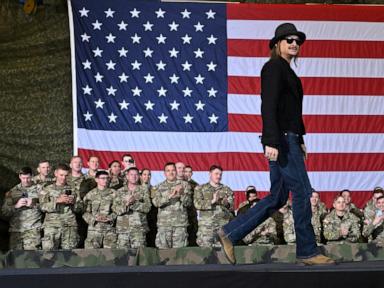
On Monday, Robert James Ritchie, known to the world as Kid Rock, traded the leather seats of his private jet for the gunner's station of an AH-64 Apache attack helicopter at Fort Belvoir. This was not a chance encounter between a rock star and the military. It was a choreographed display of political muscle, sanctioned by the highest levels of the Pentagon. While Defense Secretary Pete Hegseth describes the outing as a tribute to a "patriot," the optics tell a more complicated story of how military assets are being leveraged as backdrops for cultural warfare.
The flight comes exactly four weeks after the Army initially attempted to discipline pilots from the 101st Airborne Division for a similar maneuver. In late March, two Apaches were caught on camera hovering low over Ritchie’s Nashville estate, essentially performing a private airshow for the singer as he saluted from his poolside. The Army’s immediate reaction was standard: they suspended the aircrews and launched an administrative review into unauthorized flight operations. Then Pete Hegseth stepped in.
The Death of the Chain of Command
When Hegseth unilaterally lifted the suspensions and shuttered the investigation into the Nashville flyover, he did more than just clear two pilots. He signaled that the traditional rules governing the use of multi-million dollar military hardware do not apply when the recipient is a high-profile ally of the administration.
In a standard military environment, a pilot who deviates from a flight path to buzz a celebrity's house faces a grounded career. The AH-64 Apache is one of the most lethal and expensive-to-operate machines in the American arsenal, costing several thousand dollars per hour just to keep in the air. By intervening, Hegseth transformed a breach of protocol into a badge of honor. On Monday, that transformation was made physical when Hegseth and Ritchie took to the skies in separate Apaches, reportedly with only one pilot each to allow the two men to "ride shotgun."
The Pentagon’s official line is that this was part of "Freedom 250," a White House initiative preparing for America’s 250th anniversary. They claim Ritchie was filming promotional material for Memorial Day and his upcoming tour. Yet, the use of front-line attack helicopters—aircraft designed for tank-killing, not PR shoots—for a private citizen’s video project raises questions that the Department of Defense has yet to answer. Specifically, who is footing the bill?
Taxpayer Dollars and Political Theater
A single Apache helicopter represents a massive investment of public funds. Beyond the fuel, the maintenance requirements for these machines are grueling; every hour of flight time necessitates hours of specialized ground work. When two of them are pulled from their standard rotations for a "joyride"—a term used by investigative journalists tracking the flight data—it isn't just a scheduling quirk. It is a diversion of combat-ready resources.
Military experts often point out that "community relations" events are a staple of Pentagon life. However, these are usually defined by public access, such as airshows or school visits. The Fort Belvoir event was the opposite. It was a private, high-security excursion for a donor and vocal supporter. By framing this as a "troop touch," the administration is attempting to shield a political favor behind the popular sentiment of supporting the military.
Critics like Citizens for Responsibility and Ethics in Washington (CREW) have already filed complaints with the Inspector General. They argue that using military helicopters to fly over "No Kings" protests in Nashville—which occurred the same day as the first Kid Rock flyover—and then using those same assets to entertain a celebrity supporter constitutes a gross violation of ethics.
The New Standard of Defense Optics
For decades, the Pentagon has maintained a careful distance from partisan politics. The military is meant to be a neutral instrument of national power. That wall is currently being dismantled. When the Secretary of Defense uses his official social media to post photos of a rock star in a cockpit with the caption "Carry on, patriots," the message to the rank-and-file is clear: loyalty to the brand is as important as adherence to the manual.
This isn't about whether Kid Rock supports the troops. Many celebrities do. It is about the precedent of treating the U.S. Army as a private production company. If a musician on the other side of the political aisle had requested two Apaches for a music video after their private house-call caused a scandal, the request would have been laughed out of the Pentagon.
The Monday flight wasn't a mistake or a coincidence. It was a victory lap. It served to show that the initial scrutiny over the Nashville incident didn't matter. In the current landscape of American power, the rules of the sky are increasingly dictated by who you know on the ground.
The AH-64 Apache is an instrument of war. On Monday, it was used as a prop for a celebrity’s social media feed. As the "Freedom 250" tour kicks off, the American public is left to wonder how many more millions in military flight hours will be dedicated to the rebranding of political alliances.
The investigation into the Nashville flyover is dead, but the questions regarding the monetization and politicization of the 101st Airborne’s hardware are just beginning to surface.