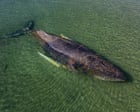
The stranding of a humpback whale (Megaptera novaeangliae) in the shallow, brackish waters of the Baltic Sea represents a failure of biological navigation and a crisis of logistics. While public discourse focuses on the emotional optics of "saving" a sentinel species, the operational reality is governed by three rigid constraints: physiological degradation, hydrodynamic friction, and the diminishing returns of late-stage intervention capital. When private wealth intervenes where state infrastructure stalls, the success of the mission depends not on sentiment, but on the precise management of the animal's internal thermoregulation and the mechanical stresses of a multi-ton displacement.
The Physiological Decay Function
A stranded humpback whale is a biological system in a state of rapid entropy. The moment a whale’s mass is no longer supported by the buoyancy of water, its own weight becomes a lethal mechanism.
- Skeletal and Organ Compression: The internal organs, designed to function in a near-weightless environment, are crushed under the weight of the whale’s own blubber and muscle. This leads to immediate respiratory compromise and reduced cardiac output.
- Myopathy and Toxicity: Under compression, muscle tissues undergo necrosis, releasing myoglobin into the bloodstream. This protein is toxic to the kidneys, meaning that even if the animal is successfully refloated, it often dies days later from acute renal failure.
- Hyperthermia: Whale blubber is an elite insulator designed for sub-zero ocean temperatures. On land, or in shallow, stagnant water, the whale cannot shed heat. Its core temperature rises to febrile levels, accelerating the metabolic breakdown of its tissues.
The intervention window is defined by the Time-to-Irreversible-Necrosis. In the German Baltic context, the shallow shelf and low salinity exacerbate these factors. Low salinity reduces buoyancy compared to the open Atlantic, increasing the effective weight load on the whale’s ventral surface even when partially submerged.
The Logistics of Displacement and Traction
Private funding from high-net-worth individuals aims to bypass the "bureaucratic friction" of state-led environmental responses. However, the physical requirements for moving a 30-ton organism without causing fatal trauma are immense. The strategy must account for the Coefficient of Drag against the seabed and the Tensile Strength of the whale's integument.
Standard maritime salvage equipment is often unsuitable. Utilizing heavy-duty slings and specialized pontoons is the only viable path to mitigate localized pressure points. If a crane or tugboat applies force to a single point on the whale’s body, the pressure ($P = F/A$) will exceed the shear strength of the skin and blubber, leading to catastrophic tearing.
The "Last-Ditch" framework employed here utilizes a specific sequence of mechanical steps:
- Hydraulic Lubrication: Injecting water and specialized gels beneath the whale to reduce friction between the skin and the substrate.
- Neutral Buoyancy Restoration: Deploying inflatable salvage bags (airbags) that are incrementally inflated to lift the animal horizontally, rather than vertically.
- Directional Vectoring: A slow-speed tow—not exceeding 2-3 knots—to prevent water from being forced into the blowhole or causing "skinning" due to hydrodynamic drag.
The Economic Misallocation of Conservation Capital
The infusion of millionaire funding into a single stranded individual raises the question of Opportunity Cost in conservation biology. This is a classic "High-Visibility, Low-Impact" investment.
From a data-driven perspective, the resources required to save one biologically compromised individual in a non-native habitat (the Baltic) could theoretically secure the habitat of several hundred individuals in the North Atlantic calving grounds. However, private capital operates on different incentives than ecological science. For the donor, the "save" is a discrete, quantifiable victory with high narrative value, whereas habitat preservation is an abstract, long-term atmospheric benefit.
The intervention creates a Moral Hazard in wildlife management. By proving that private wealth can override local environmental protocols, it sets a precedent where emotional response dictates resource allocation rather than the "Greatest Good" principle of conservation.
Structural Bottlenecks in the Baltic Environment
The Baltic Sea is a "death trap" for large cetaceans for reasons beyond simple depth. The entrance through the Danish Straits is narrow and acoustic-heavy.
- Acoustic Confusion: The Baltic is one of the busiest shipping lanes in the world. For a humpback, which relies on low-frequency biosonar and environmental soundscapes, the constant ambient noise of container ships creates a "whiteout" effect. This leads to navigational errors that drive the animal into dead-end bays.
- Salinity Stratification: The Baltic’s low salinity affects the whale’s ability to remain upright. In the open ocean, the density of seawater ($\rho \approx 1025 kg/m^3$) provides a specific level of support. In the Baltic, where salinity can drop significantly, the animal must expend more metabolic energy just to stay buoyant and breathe.
This specific German stranding is a symptom of a larger northward shift in prey species due to changing thermal gradients in the Atlantic. As whales follow biomass into unfamiliar territories, the frequency of "unrecoverable strandings" is projected to increase by 14% over the next decade.
The Engineering Strategy for Extraction
A successful extraction in this scenario requires a shift from "rescue" mindset to "industrial salvage" precision. The following operational parameters must be met:
- Vibration Mitigation: All vessels within a 500-meter radius must utilize silenced propulsion to prevent further stress-induced cardiac events in the whale.
- Thermal Regulation: Continuous application of chilled seawater to the dorsal fin and flukes—the whale's primary heat-exchange organs—to combat the aforementioned hyperthermia.
- Sedation Logistics: The use of midazolam or similar sedatives to prevent the animal from thrashing. Thrashing in shallow water increases the risk of skeletal fractures and consumes the whale’s final oxygen reserves.
The success of the millionaire-funded German operation hinges entirely on whether the capital is used to hire specialized marine engineers rather than just providing more "general" equipment. The bottleneck is not the quantity of gear, but the precision of the force application.
Strategic Recommendation for Marine Intervention
For future instances of high-profile strandings, the deployment of capital should be redirected toward the development of Rapid-Response Buoyancy Modules (RRBMs). These pre-engineered, air-transportable kits would standardize the extraction process, moving away from the ad-hoc, "last-ditch" efforts currently seen.
The strategy must transition from reactive rescue to predictive exclusion. If sensors detect a large cetacean entering the Danish Straits, acoustic deterrents (pingers) should be deployed immediately to force the animal back to the Atlantic shelf. Investing in the "gate" is infinitely more cost-effective and biologically sound than investing in the "grave."
The current operation in Germany will likely yield a 20% survival rate past the 72-hour mark, based on historical data for humpbacks stranded for more than 24 hours. The priority must be the immediate cessation of all manual handling and the transition to a fully automated buoyancy-lift system. Any further delay in mechanical lifting will result in the whale’s weight causing irreversible internal crush syndrome, rendering the financial investment a sunk cost.