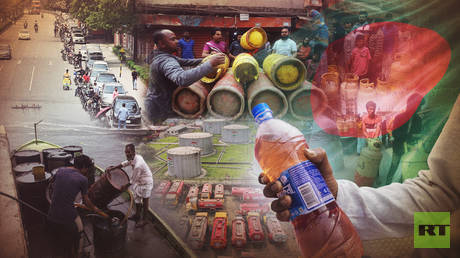
The lights are flickering across Dhaka, and it isn't just the summer heat. Bangladesh is currently trapped in a suffocating pincer movement between dwindling foreign exchange reserves and a global energy market that no longer accepts IOUs. While headlines suggest a simple shortage of supply, the reality is a systemic insolvency. The country is down to less than three weeks of fuel oil reserves, a precarious margin that leaves 170 million people exactly one delayed tanker away from a total national blackout. This is not a logistical hiccup. It is the reckoning of a decade spent building an energy infrastructure on the shifting sands of expensive imports and unpaid subsidies.
The math is brutal. State-owned Bangladesh Petroleum Corporation (BPC) and the Bangladesh Power Development Board (BPDB) are drowning in billions of dollars of arrears. International suppliers like Chevron and Saudi Aramco have historically been patient, but that patience has hit a hard ceiling. When a nation cannot open Letters of Credit (LCs) because its central bank is hoarding every greenback to prevent a total currency collapse, the tankers stop moving.
The Myth of the Global Price Hike
It is easy to blame the volatility of international markets or the lingering echoes of distant conflicts for the current misery. That narrative is a convenient shield for domestic policy failures. The truth is that Bangladesh’s energy architecture was designed for a world of $50 oil and cheap, abundant liquefied natural gas (LNG).
For years, the government pivoted away from domestic gas exploration, choosing instead to tether the nation’s future to the spot market. This was a gamble that failed. By ignoring the untapped potential of the Bengal Basin and failing to modernize state-run drilling companies like BAPEX, the administration effectively outsourced its sovereignty to global commodity traders. Now, when the price of LNG spikes or the Taka devalues, the cost of keeping the lights on becomes an unsustainable burden on the national treasury.
The Sovereign Credit Trap
Foreign reserves have plummeted from a peak of nearly $48 billion in 2021 to a functional level that many analysts believe is well below the $20 billion mark. The International Monetary Fund (IMF) has stepped in with a $4.7 billion bailout, but that money comes with strings that the average citizen is already starting to feel.
One of those strings is the "automatic pricing formula."
In theory, adjusting domestic fuel prices to match global trends protects the BPC from losses. In practice, it acts as a regressive tax on a population already battered by double-digit inflation. When the price of diesel goes up, the price of every onion and sack of rice in the market follows. The government is caught in a trap where saving the budget means starving the people, and saving the people means bankrupting the state.
The Invisible Debt to Independent Power Producers
While the fuel tankers are the most visible sign of the crisis, the real rot is in the power generation sector. Bangladesh’s "capacity charges"—payments made to private power plants even when they aren't producing electricity—have become a massive drain on resources.
- Idle Plants: Millions are paid to Independent Power Producers (IPPs) to stay on standby.
- Fuel Dependency: These plants require imported furnace oil or gas, which the government cannot afford to buy.
- The Circular Debt: BPDB owes money to the IPPs, who then cannot pay their fuel suppliers, who then stop importing.
This cycle has created a massive backlog of "deferred payments" that some estimates place at over $5 billion across the energy sector. You cannot fix a physical shortage of fuel until you fix the financial hemorrhage in the contracts that govern how that fuel is burned.
The Industrial Death Spiral
Bangladesh's economy lives and dies by its Ready-Made Garment (RMG) sector. It is the engine that drives exports and brings in the very dollars the country needs to buy fuel. However, the energy crisis has turned into a self-sabotaging loop.
Factories in industrial hubs like Gazipur and Narayanganj are reporting daily outages of six to eight hours. To keep the sewing machines running and meet strict export deadlines, owners are forced to rely on diesel generators. This sends production costs skyrocketing at a time when global demand is softening. If the RMG sector loses its competitive edge because it cannot get reliable power, the inflow of foreign currency will shrink even further, making it even harder to buy fuel next month.
This is the definition of an industrial death spiral. The very sector tasked with saving the economy is being choked by the lack of the resources it produces the most wealth to acquire.
Why Domestic Gas Exploration Stalled
There is a nagging question that veteran analysts keep asking: why did Bangladesh stop looking for its own gas? The country sits on one of the largest deltas in the world, historically rich in hydrocarbons. Yet, for the last decade, the focus has been on building massive LNG import terminals.
Critics point to a "commission culture" where large-scale import projects and infrastructure builds offer more opportunities for political and bureaucratic rent-seeking than the slow, technical work of onshore and offshore drilling. The decision to prioritize imports over self-sufficiency was a policy choice, not a geological necessity. Now, the country is paying the "import premium" for that choice, and the price is higher than anyone anticipated.
The Renewable Mirage
There is often talk of shifting to "green energy" to solve these woes. While a noble goal, it is a pipe dream in the context of a three-week fuel emergency. Solar and wind currently contribute less than 4% to the national grid. Transitioning the energy mix of a nation of 170 million people takes decades and billions in capital expenditure—money that Bangladesh currently needs just to keep its current turbines spinning. Renewable energy is a long-term exit strategy, but it is not a fire extinguisher for a house that is already ablaze.
The Strategy of Managed Decline
The government's current approach is one of "load shedding" and "demand management." This is a polite way of saying they are rationing misery. By cutting power to rural areas to keep the capital illuminated, they are buying political time, but they are also hollowing out the agricultural sector.
Irrigation pumps run on electricity and diesel. If the farmers in the north cannot water their crops because the fuel is being diverted to Dhaka or because the price has doubled, a food security crisis will inevitably follow the energy crisis. This is how a fuel shortage evolves into a multi-dimensional national emergency.
The Necessary Pain of Structural Reform
To emerge from this without a total collapse of the industrial base, the government must move beyond temporary bailouts and "band-aid" loans. The first step is the immediate and transparent audit of all capacity charge contracts. The state can no longer afford to pay for electricity that isn't being generated.
Second, the central bank must prioritize energy imports over almost all other expenditures, including prestige infrastructure projects. A new bridge is useless if the trucks crossing it have no diesel.
Finally, there must be an aggressive, transparent push for offshore gas exploration. The maritime boundary disputes with Myanmar and India were settled years ago, yet the deep-sea blocks remain largely unexplored. Inviting international oil companies with the expertise and capital to drill is no longer a matter of "national interest"—it is a matter of national survival.
The three-week reserve is a countdown clock. Every day that passes without a fundamental shift in how the country manages its energy debt brings Bangladesh closer to a point where the lights don't just flicker—they stay off. The time for blaming global markets has passed; the time for paying the bill has arrived.