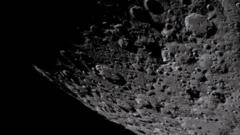
We’ve spent fifty years staring at the same grainy, washed-out shots of the lunar surface. If you grew up with the Apollo 8 "Earthrise" as your desktop background, I’ve got news for you. The images coming back from the Artemis II crew—Reid Wiseman, Victor Glover, Christina Koch, and Jeremy Hansen—are a total reset for our collective imagination. They didn't just see the Moon; they saw a high-definition, mineral-rich world that makes the 1960s missions look like they were filmed through a basement window.
It's been a wild week for the crew of the Orion spacecraft. On April 6, 2026, they reached the farthest point any human has ever traveled from Earth, clocking in at 252,756 miles. But the real story isn’t the distance. It’s what they saw when they looked out those five thick windows during their seven-hour pass over the lunar far side.
The 54 Minute Eclipse You Didn't See
On Earth, a total solar eclipse is a frantic four-minute sprint. You blink and you miss it. For the Artemis II crew, it was a marathon. Because of their unique position in deep space, the Moon appeared massive—large enough to block the Sun for nearly 54 minutes of totality.
Imagine floating in a silent cabin, 4,000 miles above the cratered dirt, watching a "solar eclipse of the heart" that just wouldn't end. The crew actually had to use eclipse glasses inside the spacecraft. While we usually see a bright white corona from the ground, the astronauts saw the Sun’s outer atmosphere as a glowing, delicate halo around a pitch-black lunar disk. Because the Moon was blocking the Sun's glare so effectively, they could see stars that are usually drowned out. They even caught a glimpse of Venus hanging like a diamond next to the eclipsed Moon. It’s a perspective no human has ever had, and frankly, it makes our terrestrial eclipses look like a rehearsal.
Not Just Gray Rock
One of the biggest lies we’ve believed about the Moon is that it’s just a monochrome ball of dust. The processed data from the Artemis II flyby tells a different story. When you look at the images processed by experts like Damian Peach using the raw sensor data, the "gray" disappears.
- Vibrant Oranges and Yellows: These aren't artifacts; they’re iron-rich basalts from ancient lava flows in the Maria.
- Deep Purples and Blues: These mark titanium-bearing ilmenite deposits.
- Striking Cyan: The Aristarchus crater glows with a distinct teal hue that stands out against the darker plains.
The crew spent hours documenting these color variations. Christina Koch and Victor Glover were glued to the windows, snapping thousands of frames as they crossed the "terminator"—the line where lunar day meets night. At this boundary, the low-angle sun stretches shadows across craters like Vavilov and Hertzsprung, making the terrain look more like a jagged mountain range than a flat desert.
The Earthset Moment
We’ve all seen Earthrise. But the Artemis II crew captured "Earthset" at 6:41 p.m. EDT. Watching our blue marble slip behind the jagged limb of the Moon is a gut-punch of a visual. In the foreground of their most famous shot, you can see Ohm Crater, a complex structure with terraced edges and a flat floor.
It’s easy to get caught up in the "pretty picture" aspect of this, but there’s a heavy dose of reality here too. Commander Reid Wiseman mentioned how the entire crew was "paused in their tracks" by the sight of Earth's auroras glowing green from a quarter-million miles away. You aren't just looking at a planet; you’re looking at every person you’ve ever known, tucked into a tiny blue sliver while you’re surrounded by the infinite vacuum.
Why This Flyby Was Different from Apollo
The Apollo missions hovered roughly 70 miles above the surface. Artemis II stayed much higher, between 4,000 and 6,000 miles. You might think being closer is better, but the higher altitude gave this crew a "basketball at arm’s length" view of the entire lunar disk. They could see the poles, the far side, and the near side all in one sweeping gaze.
They also had better tech. They aren't using film that needs to be developed in a lab a week later. They’re using high-end digital sensors and, honestly, even iPhones to beam images back to Houston in near real-time. This isn't just about exploration; it's about the democratization of the view. We're seeing what they see, almost as they see it.
What Happens Now
The crew has already performed their return correction burn. They’ve exited the Moon’s sphere of influence and are currently screaming back toward Earth. If you’re following along, the next few days are all about the high-stakes reentry.
Don't just look at the photos and move on. Download the high-resolution raw files from NASA’s gallery. Look at the mineral colors in the Orientale Basin. Study the way the shadows fall in the Birkhoff Crater. We won't be back in this specific spot for a while, and these images are the blueprint for where the Artemis III crew will eventually put boots on the ground. Keep your eyes on the splashdown schedules; the journey home is often the hardest part.